Table 1
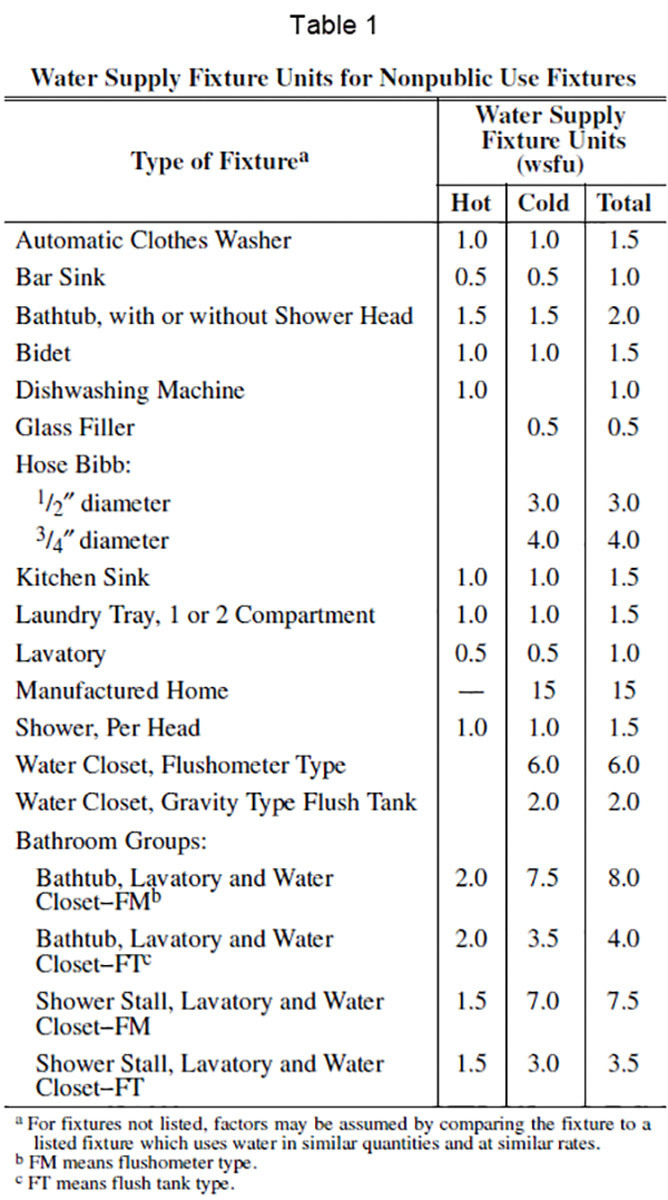


Figure 2

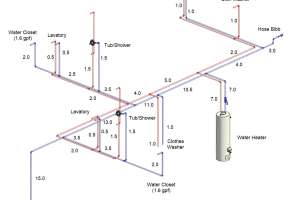
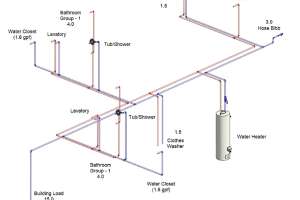
Table 1
Figure 2
In September of 2020, I wrote an article for Plumber (“Size Matters”) related to sizing water distribution systems and retrofitting them with tankless water heaters and/or water treatment equipment.
The goal of that article was to give you a heads-up, so to speak, that simply replacing a tank-type water heater with a tankless type, was more than making a couple cuts in the piping and splicing in a new unit. I shared some insight on the amount of pressure loss and possible consequences the water distribution system could incur from installing these types of heaters and water softeners if not properly sized.
In this article, we’ll take a step back and look at how to properly assign the total loads to the entire water distribution system. My following articles will pull everything together and eventually size the entire system properly.
Step 1: Define the water distribution piping.
Code A: In a building or premises, a pipe that conveys potable water from the building supply pipe to the plumbing fixtures and other water outlets.
Code B: A pipe within the structure or on the premises that conveys water from the water service pipe, or from the meter when the meter is at the structure.
Code C: “Water distribution system” means that portion of a water supply system from the building control valve to the connection of a fixture supply connector, plumbing fixture, plumbing appliance, water using equipment or other piping systems to be served.
As I love to point out in my articles, there are different codes and differently written definitions, yet in the end, we as plumbers are required to understand them and install safe plumbing systems in accordance with our local code and the Authority Having Jurisdiction (AHJ).
Step 2: Determine the use of the fixtures to which water will be supplied.
Private or Non-Public Use Fixtures
Code A: Applies to plumbing fixtures in residences and apartments, to private bathrooms in hotels, hospitals and health care facilities, and to restrooms in commercial establishments where the fixtures are intended for the use of a family or an individual.
Code B: In the classification of plumbing fixtures, “private” applies to fixtures which are not public.
Code C: Nonpublic means, in the classification of plumbing fixtures, those fixtures in residences, apartments, living units of hotels and motels and other places where the fixtures are intended for the use by a family or an individual to the exclusion of all others.
Public Use Fixtures
Code A: Public or Public Use. Applies to plumbing fixtures that are not defined as private or private use.
Code B: Public or Public Utilization. In the classification of plumbing fixtures, “public” applies to fixtures with unrestricted exposure to walk-in traffic.
Code C: “Public” means, in the classification of plumbing fixtures, those fixtures which are available for use by the public or employees.
Remember, I didn’t write the codes. I’m just writing about them! Haha!
Step 3: Assign the Water Supply Fixture Units (WSFU) to the plumbing fixtures
All plumbing codes have developed a table which indicates the WSFU values for various plumbing fixtures and appliances. These values can be traced back to the original research of a gentleman from the 1940s by the name of Roy B. Hunter. I’m not going to attempt to explain who he is and the incredible impact he has had on the industry it in this article, but I encourage you plumbing history buffs to do a Google search about him for more info.
Following is an example of the WSFU tables from Code C: (see tables above)
Notice that the top of each table indicates whether the fixture use is public or non-public. We will discuss this more in the future, but for now, let’s focus on non-public use fixtures (Table 1).
Next let’s break the table down a bit. The first column indicates the type of fixture or appliance. The second column (WSFU) is broken into three sub-columns: hot, cold, and total. For this next step, we need to gather the total loads and assign them to the following drawing
Figure 1 is a simple two bath home which we will use for this discussion.
For Code C, total loads would be as follows: 1/2-inch hose bibb/outdoor faucet (3.0), kitchen sink (1.5), dishwasher (1.0), clothes washer (1.5), 2-bathroom group (includes flush tank water closet, lav, and tub/shower combo) (four each at 8.0), for a total of 15.0
As I often try to do in my articles, here is a comparison of the total loads from Code A and B:
It still amazes me that Codes A, B, and C, are very reputable plumbing codes in the United States, but still are not uniform!
The thing I truly love about our industry is that it is ever changing. We learn new things and work together to adjust the way things get done. Due to the pandemic, many public buildings were shut down or barely occupied and an increase in stagnant water led to a spike in cases of Legionella in the past two years. This has caused great safety concerns in the way that water distribution systems are designed. As I write this article, I am coming off of the tail of a recent summit on the development of a public use version of IAPMO’s Water Demand Calculator (WDC).
A “think tank” is being put together with some of the plumbing industry’s brightest people to take part in the next step in the development of a public version of the WDC. I’ll keep you advised as things develop.
You can check out the residential version of the WDC at www.iapmo.org/water-demand-calculator/. This calculator is a game-changer when it comes to sizing and I encourage you to try it out. I hope to have more info in coming articles for you on it as well as a look at how to apply it to designing a water distribution system.
As you look at Figure 2, you’ll see that the total loads of the fixtures have been applied to both the fixtures or groups of fixtures (aka bathroom groups) and to the building. This step may seem basic or even useless to some, but trust me, it’s the basics that build the system correctly.
In my next article we’ll get into sizing but for now, you can see that the water distribution is “totally loaded.”
------------
Randy Lorge is a third-generation plumber and the director of workforce training and development for the International Association of Plumbing and Mechanical Officials (IAPMO). Lorge is also a member of the planning team for the International Water, Sanitation and Hygiene Foundation (IWSH). This 501(c)(3) foundation has completed water and sanitation projects for those less fortunate in India, South Africa, Indonesia and, more recently, the United States. He enjoys time with his family and spending as much time as possible in his deer stand. To contact Lorge, email editor@plumbermag.com.
Continue reading for free