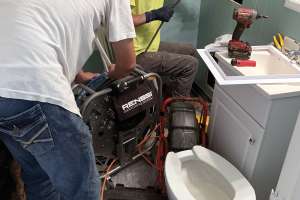
Clogged drains. They’re messy, drain machines take up extra room in your service van, and a lot of plumbers just don’t like clearing them.
If you’re running a plumbing company and only clearing drains when you have to, you’re possibly cutting your revenue in half. Drain clearing provides opportunities that plumbing alone can’t. Look at your Indeed ad and get ready to make some changes to attract drain cleaners to your business.
Here are some things plumbing-only companies are missing out on and how to capitalize on clearing drains.
I’m a plumber by trade, but here at Service Nation, I deal with a lot of HVAC companies as well. HVAC companies have done a very good job of boosting sales through the installation of newer, more efficient heating and cooling systems. The bulk of their revenue is from replacing systems.
How does this relate to drains?
If a main sewer is clogged with roots, or as the result of some type of damage to a sewer or drainline, the recommendation should be to make a repair on that pipe, or even to replace that line if it’s in poor condition. If you don’t have the tools, training or personnel to clear the drain, diagnose the problem, make the recommendation to repair or replace the line and a crew to get the job done, then you’re leaving half of your potential revenue for another company to claim. If you don’t make the repair, someone else will. The repair or replacement of the line is the plumbing equivalent of replacing an existing HVAC system.
HVAC companies have “comfort advisers” that go into a home, evaluate the system, and make recommendations to their customers on which system would be best for them. Does your company have something similar? When I was in the field, we had dedicated camera technicians that would go out on main sewer line jobs when the technician encountered roots or felt that there was some other issue that needed to be addressed. The camera technician would look at the damaged sewer line, often with the customer standing by, and they would show the customer the issues that were found and they would make recommendations. Not only is a good drain tech a valuable addition to your company, but a good camera tech is as well.
Do you think your customer has thousands of dollars set aside for repairing a sewer line? Probably not. Those comfort advisers are prepared for this. They don’t just go to a customer and say it’ll be $8,000 for a new system. They have finance companies that they work with, so they can give a much softer potential monthly payment amount. If you have a finance company that you work with, your camera tech can do the same thing. “Mr. and Mrs. Jones, we can replace that broken sewer for $125 a month.” Doesn’t that sound better than quoting $8,000?
STARTING THE PROCESS
I know that some of you reading this have considered adding drain cleaning to your business, but it’s just so hard to get plumbers to buy in. I have a question. Are you marketing as hard to find new plumbers as you do to get the phone to ring? If no, you should be, and you can market just as hard to find an experienced drain cleaner. Drain technicians often require no special license, and the training process is much faster than that of plumbers, so once you do find an experienced person that fits into your company, hire an apprentice to learn the job. A good trainer can have an apprentice ready for their own truck in about four months. If you’re marketing drains well enough, you can double your drain revenue in 4-6 months.
You’ve found the right person for the job and now you need to have the right equipment. This will take some investment. Find a good set of drain machines that will clean anything from bath sink drains to main sewer lines. If you’ve been lucky enough to hire an experienced drain tech, ask them what they like to use and get that equipment. Next, get a good camera. Something sturdy and that has a picture clear enough to show your customer what their issues are clearly.
MOVING BEYOND DIAGNOSTICS
Now that you are staffed, and you have the equipment to properly diagnose your customer’s drain issues, it’s time to talk about replacement options.
The obvious option is through excavation. In some cases, excavation may be your only choice, but let’s talk about other repair options.
I started doing pipe patching, lining and bursting years ago and I can say that the equipment is better now, and the training is much better. Back in the day, if you struggled with bursting or lining, you were on your own to find creative ways to get yourself out of a jam. Now there are companies like American Pipelining Supplies that will sell you the equipment and that will provide a high level of training and support.
The cost for a small company to invest in lining and patching is very reasonable with a high return on investment. Once you’re all set up with equipment, technicians and training, you have the ability to line that sewer line from the basement to the city main without having an excavator, shoring and a crew onsite to do the work. Two technicians can line that pipe in less than a day, often through an existing cleanout. The days of having to dig a 10-foot-deep trench that’s 60 feet long can now be few and far between.
Our friends in the HVAC industry have perfected a system to service, and sell, equipment to their customers. Those of you that have a similar system for plumbing and drains, good for you. For those of you that don’t, consider stepping into the drain arena with the possibility to double your company’s revenue.
------------
Dave Bailey is the vertical market manager, plumbing for Service Nation and has 25 years working in the plumbing industry — 23 in the field. If you would like to send a message to him, email dbailey@servicenation.com.
Continue reading for free