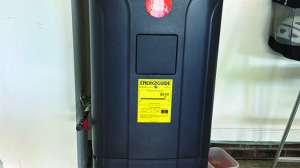
An employee at the A. O. Smith manufacturing plant in Ashland City, Tennessee, works on a water heater unit.

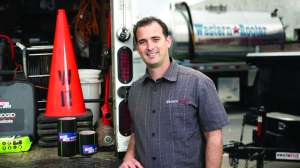
David Chisolm

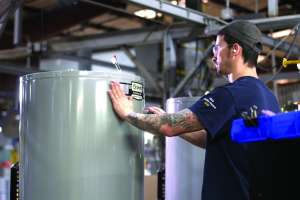

An employee at the A. O. Smith manufacturing plant in Ashland City, Tennessee, works on a water heater unit.
David Chisolm
Twists and turns. That is what sums up the long history of A. O. Smith and how the manufacturing company went from building car frames to water heaters, boilers and more in the plumbing industry.
“The history is just fascinating because it’s a long-standing American-manufacturer durable goods product company that has a rich history throughout the years,” says David Chisolm, general manager of APCOM and Water Systems, a division of A. O. Smith.
Chisolm has been with the company for 20 years and prior to taking on the general manager role with APCOM was vice president of marketing for A. O. Smith’s water heater division.
In a recent question and answer with Plumber magazine, Chisolm talked about what makes A. O. Smith the company it is today and how they serve customers.
“It’s built into our core at A. O. Smith to use our engineering minds to solve customer problems and solve them in new, innovative and different ways,” Chisolm says. “We stay really close to our customers and understand the trends of the industry, the needs of the industry, the customer demand, and then develop products that solve those needs.”
Plumber magazine: How does APCOM fit into A. O. Smith?
CHISOLM: APCOM, really simple, stands for Appliance Component. APCOM makes the large component parts that go into all of our water heaters. It’s part of the A. O. Smith family, so it’s part of the whole vertical integration where all of those components come out of our factory here and go to our water heater factories. Heating elements, burner tubes, pipe nipples, a lot of the component parts that go into the water heater, we make and then send to our facilities. Then they take these components and the raw steel that comes in and it comes out a full water heater.
Plumber: A. O. Smith is celebrating 150 years this year. Can you tell me a little bit of the history of the company?
CHISOLM: C.J. Smith was our founder and immigrated from England. He came to the United States and was going to set up shop and ended up settling down in Milwaukee and opened a general machining shop in 1874. It was a general blacksmith — bending and welding of metal originally. He started off making components for baby carriages, transitioned to making component parts for bicycles and then right at the turn of the century a gentleman by the name of Henry Ford approached the Smith family and asked to partner up with this new technology called the automobile. So when you read in the history books about Henry Ford and how he revolutionized manufacturing, you don’t often read that A. O. Smith was hand-in-hand with that. We got an order for 10,000 automobile frames, had no idea how to do it and ended up building a facility that was an engineering marvel because it was a very highly automated and repeatable process. So we were able to put out automobile frames, high quality, high repeatable, low-cost and ended up partnering with the Ford family and made millions upon millions of automobile frames over the course of the years.
You play that forward, bending and welding of metal, we got into large-diameter pipe, so a lot of the natural gas and oil distribution lines across the U.S. are A. O. Smith-produced pipelines. A recurring theme in our history is how we solve big problems of the day, how we put our engineering minds and innovative minds to solve these problems in new and novel ways. Flash-forward to the 1930s, coming out of the Great Depression, one of our engineers was working on a project with the beer industry.
Beer was getting to be mass-produced in large storage vessels. The problem is the larger the storage vessel you make it out of steel, then you get flavor exchange, you get corrosive properties of the beer. They needed a way to protect those storage vessels. So our engineers were working on solving that problem and as the story goes, this was coming out of the depression and we were really trying to focus on just a few core things, so any kind of external project that wasn’t core to our business was at the time, they shuttered those projects. The story is the engineering manager went to the engineers and said, ‘Hey, this glass lining process that you’re working on, we need to stop that because it’s not core to who we are.’ And they were so close. The engineers ended up working on it on their own time because they were so close and what they figured out is how to glass line steel, so take a ceramic coating and coat a steel tank for the purpose of protecting that steel tank. They ended up figuring that out and patenting that process. That was in 1936.
That spun off a bunch of other businesses.
That glass-lining process is also what enabled us to get into water heating. One of the challenges around water heating was typically they were custom-made, they were very expensive back in the day. While patenting the glass-lining process with steel, we were able to make water heaters cost effectively, high-quality, high-repeatability and make it for the masses. That was in the late 1930s when we started using that patent for making water heaters and the rest is history.
Now, A. O. Smith as we know it is a water technology company, so we’re water heating and water treating, water filtration, water softening and water heating and boilers are our core competencies now.
Plumber: The industry has changed over the years, how does A. O. Smith keep up with the technological advances over the years?
CHISOLM: Tankless has seen a lot of growth in the marketplace. I’ve been with A. O. Smith for 20 years and when I first came to A. O. Smith, tankless was a fledgling industry. This year tankless is going to sell, as an industry, over a million units. So as a base of 10 to 11 million units as an industry annually, tankless is 10% of the overall volume. We’ve seen that change, we’ve seen that growth and we’re investing and developing products to take care of our customers and bring them solutions that they want.
One of them is our knowledge in water heating and our knowledge of treatment. We’ve grown through acquisitions on the water treatment front, so we understand reverse osmosis, we understand carbon blocking and we understand water heating and our history there, so when we were looking at developing a new tankless product we asked what are the problems we need to solve? One of them is making our products easy to install for our contractors. We have a product that’s indoor or outdoor, natural gas or LP, two inch or three inch vent, 1/2-inch or 3/4-inch gas line, so we have all of the features covered, but another aspect of tankless that no one really talks about is the requirement for annual maintenance. A lot of the areas in the U.S. have hard water, and what is not really talked about that often is that hard water and tankless water heaters don’t get along very well.
If you know tankless, it’s heat exchangers and air tubes. Water passes through a tube and you have a big burner underneath that does the heat exchange. As those tubes get blocked with buildup, with scales, then at some point that water heater is going to fail. Some manufacturers say the warranty will void if you have X-grains of hardness or if you don’t do annual maintenance. We understand people will typically install water heaters and maybe not think about it that much. So how do we design a product that is going to work and not require annual maintenance like flushing or descaling, so that’s what we set out to do, was design a tankless water heater that was intended for use in the U.S. with our water quality conditions and with our lack of annual maintenance, so that’s what we did.
We designed it from the ground up, the heat exchanger is designed in a way that minimizes the scale buildup, it’s actually a circular heat exchanger and has two passes. On top of that we have integrated scale prevention technology built into the tankless as an integrated system. It’s literally the first water heater that doesn’t require annual maintenance. It’s a no-maintenance tankless water heater, we just launched it. It’s called the Adapt Series. We’re getting a lot of interest and pickup with that product in the industry.
Plumber: Any plans on putting that technology in boilers, combi-boilers or anything similar?
CHISOLM: We’re looking to see how we can take this technology and apply it into other areas of business also. We just saw that tankless was the low-hanging fruit in terms of having a need there and being able to take our knowledge to low-hanging fruit. We’re looking at other areas to apply the knowledge.
Plumber: What else is new this year?
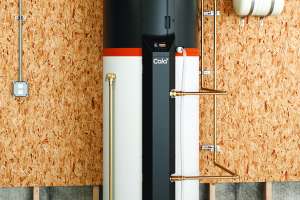
CHISOLM: We’re significantly investing in heat pump technology. So a heat pump is not a new technology — it’s not even new in water heating, it’s been around since the 2010, 2011 timeframe, but it’s started to get more traction and more broadly adopted, so we’re investing heavily in heat pump water heaters.
Instead of a traditional electric water heater where you have your elements on the side of the tank and you heat the water through energizing those electric elements, what we’re doing as primary heat source is we’re borrowing energy from the surrounding areas, so in a residential setting that would look like a garage or a basement or some other area where you have plenty of air exchange, plenty of ambient heat and you’re pulling that heat from a surrounding area.
You’ve got a compressor, you’ve got refrigerant, you’ve got a condenser and you take that energy and put it into the refrigerant and that refrigerant transfers that energy to the tank into the water and the byproduct is cooler, dehumidified air. It’s a much more efficient way to transfer energy. The benefit to the end user is much lower utility bills.
A. O. Smith is all in on heat pumps and developing heat pump technologies and applying it into our product line more broadly. You’ll see heat pumps that integrate leak detection, that integrate connectivity, so that you can change settings on your phone or can even connect up with the local utility and consume when they have variable rate pricings, so you’re using electricity when they have lower rates and you’re not using electricity at their higher rates.
I call the heat pump water heaters the best kept secret in the water heater business. They’ve been around for years, but it’s now catching its stride and people are paying attention and realizing the benefits to energy efficiency and including that new technology in and we’re seeing a lot of interest in that.
Plumber: Part of having that new technology is having the plumbers to install it. How do you develop that relationship and make sure they are able to install those products?
CHISOLM: It’s critical in the adoption of these new products. Historically in the past, the question was always do you want tank or tankless and that was kind of it. That was the question and things went from there. Now, you’ve tanked, tankless, you’ve got a heat pump, you’ve got condensing tankless, you’ve got condensing tank type, you’ve got a range of solutions. It’s even more critical that our channel partners know about the technologies, are comfortable with the technologies, are comfortable with installing them, servicing them, recommending them and how to have that conversation with the customer about the technology.
All of that we take very, very seriously and we feel it’s our job in the industry to walk alongside our industry channel partners and make sure that we have a focus on training, that we have a focus on education, on product application, on specifications and we’re giving our customers the tools they need to do their jobs effectively.
We’ve spent a great deal of time, energy and resources on training, on training studios, labs, hands-on training, digital content, video creation, livestreaming training. We’ve got a state-of-the-art training facility just outside of Nashville.
Plumber: What’s ahead for A. O. Smith? Not only for this year, but future years?
CHISHOLM: I’ve been here for 20 years and I tell people all the time that I have not seen the rate of change and volume of change that we see now in my history here. What’s ahead of us? A lot of change, hang on.
It’s consumer preferences that are changing, commercial application specifications are changing, the technology, the regulatory environment.
We have to, in order to make it to the next 150 years, continue to innovate, adapt and be resilient through all these changes. It’s a focus on our customer, new product development and bringing products to market that matter that our customers want and are asking for and making sure we are investing ahead of the curve.
Continue reading for free