
For those cleaning sewer lines, dreaded “blown toilets” can quickly become a community cleanup and public relations nightmare.
“A ‘blown toilet’ can leave sewer material on a homeowner’s floor and toilet seat, raising tensions in the community,” says Dan Story, operations manager at nozzle manufacturer KEG Technologies.
Blown toilets typically occur when the operator rushes up the sewer line with little or no cleaning going up the line on the first pass. This results in excessive piles of debris on the return trip through the same stretch of sewer line. Air flow from the jet nozzle then compresses between the nozzle and the debris, creating significant positive pressure, according to Story.
“When the debris passes by a home’s service line, the pressurized air blasts up and out of the service line, causing a blown toilet,” he explains.
Other circumstances, such as failing to open the upstream manhole when cleaning sewer pipes, can also multiply the incidence of blown toilets. This can increase pressure in the system, leading to blown residential toilets when sewer gases flow up the laterals and cause wastewater to overflow.
Now, KEG Technologies has redesigned and renamed a specialty nozzle used to prevent blown toilets, making it widely available at a fraction of the cost with greater mobility. The new nozzle, which at least one Los Angeles area municipality has found affordable to use on several of its sewer trucks, offers the possibility of eliminating blown toilets throughout the sewer cleaning industry.
Due to the ill will generated by blown toilets as well as the community cleanup required, KEG previously developed a specialty nozzle called the Equalizer designed to virtually eliminate blown toilets. In this model, 12 forward jets at dual angles not only clean but also create an umbrella pattern which blocks the airflow that can create problems with blown toilets. Six rearward jets with KEG’s high-efficiency fluid mechanics provide superior propulsion, cleaning, and debris removal.
Although the nozzle is effective, its relatively high cost has put it out of reach for many operators, making it a specialty item shared among a fleet. In search of a more universal and economic solution, KEG invested in R&D and testing to create a new, improved, more affordable nozzle designed to prevent blown toilets, according to Story, who was instrumental in its development.
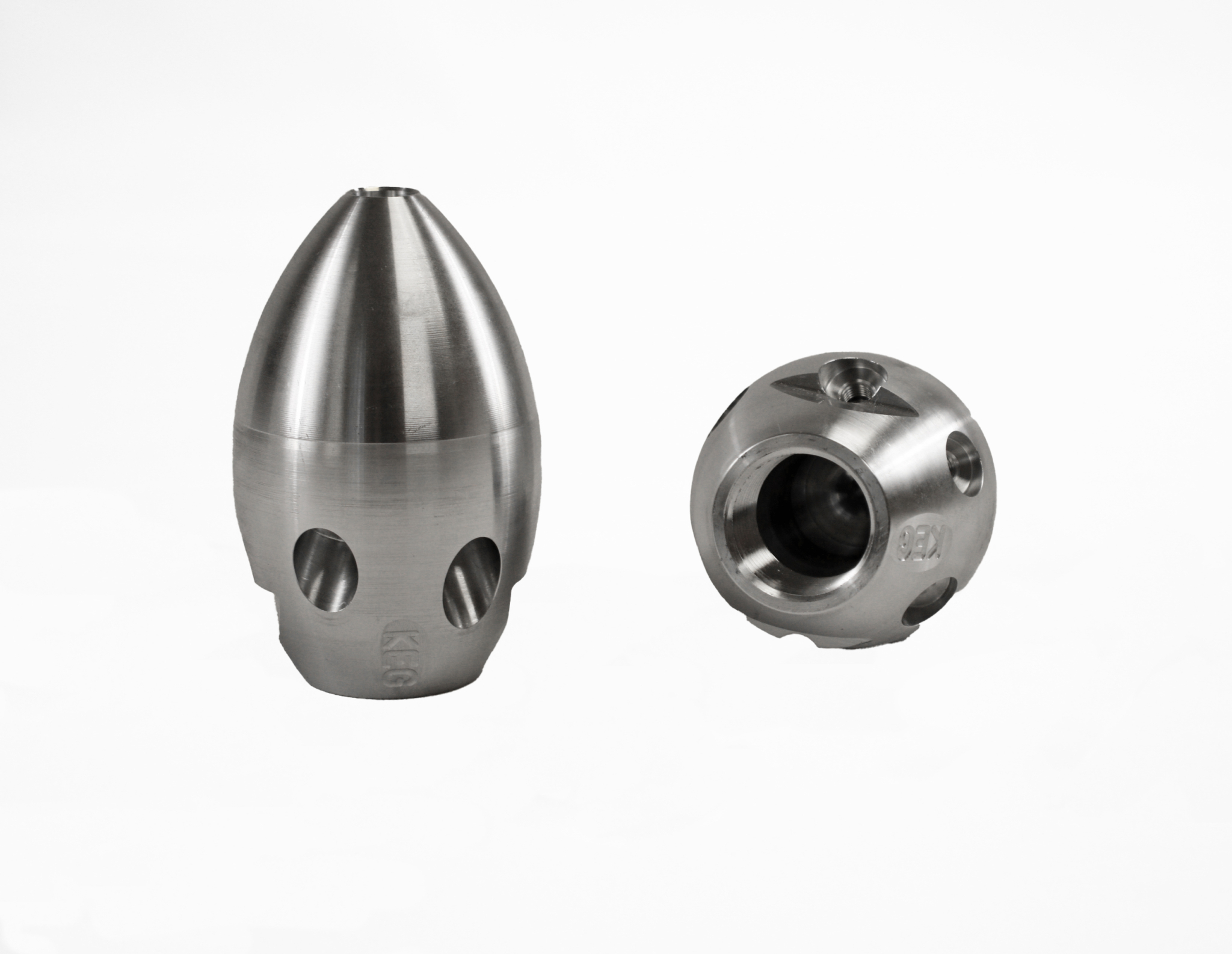
“I designed a new nozzle specifically to prevent blown toilets. The nozzle, called the Toilet Tamer, substantially improves upon a previous, more costly design [the Equalizer],” Story says.
According to Story, with the precisely engineered water jet angles incorporated into the nozzle, the Toilet Tamer is designed to dramatically reduce the amount of airflow being pulled through the pipe.
“Virtually eliminating the amount of pressurized air present as the operator passes by a home’s service line prevents any sewer material from being blown up and out of residential toilets. So, no more ‘blown toilets,’” Story says.
Unlike the prior design, which can be challenging to navigate through pipes, the new nozzle is tapered like a football on both ends. The streamlined design eliminates hangups and ensures smooth passage through even misaligned or separated pipes.
The innovative nozzle is Tier 3 with exceptional water efficiency up to 90%, which translates into more sewer line cleaned per day with fewer operator trips to refill the truck’s water tank.
The most significant advances, however, are design and fabrication changes that dramatically lower the cost.
“The new Toilet Tamer nozzle costs about one-third of our previous model [that it’s based on], but is actually more effective in the field. We could charge more, but our goal is to put it in the hands of operators nationwide to solve the problem of blown toilets,” Story says.
The new nozzle has already been successfully field-tested, according to Story. A city north of Los Angeles initially tried it for a few weeks.
According to Story, when the city’s operators tested the nozzle, they set it up in a 10-inch pipe above ground with a 6-inch lateral branching off. When they placed their hand over the 6-inch pipe, they could not feel any significant vacuum — nothing like what they would normally expect. This was the first indication that the design was working as intended.
The city’s operators then moved about 300 feet up the line, just before it entered a manhole. At that point, a small amount of water was pooled at the edge of the pipe, and surprisingly, the nozzle did not even pull that water all the way in. That is when they realized just how effective it was. It appeared as if there was no air movement at all.
Impressed with the results, the city has ordered four more, equipping their sewer trucks and stocking their warehouse to ensure that the new nozzle is readily available for operators when needed.
Story is conducting additional testing on the new nozzle to document how air moves around it in the field.
“We’re applying science to solve one of the most aggravating problems that operators and municipalities have faced for many decades,” Story says. “The goal is making the nozzle not only effective at eliminating blown toilets, but also very economical so that it’s available to operators and fleets whenever and wherever needed.”
For more information, visit www.kegtechnologies.net.
Continue reading for free