Furthermore, in 2019 CenterState CEO, a regional economic-development agency, and the Upstate Minority Economic Alliance named NJ Jones Plumbing the area’s Minority Business of the Year.
About 90% of the company’s business stems from new construction plumbing.
In short, Jones, age 48, is light-years away from that dark time in his life decades ago. And plumbing was the lifeline that helped him get there.
“That time spent in jail definitely saved me,” says Jones. “It did what it was supposed to do — reform me and turn me into a better citizen.”
KEYS TO SUCCESS
The primary keys to Jones’ success? A steadfast work ethic. A knack for plumbing. Learning from mistakes. Investments in technology. And becoming a minority business enterprise (MBE), which helped him build a solid customer base.
“I was the first minority master plumber in Onondaga County,” he says. “I’m also a workaholic and I love what I do.”
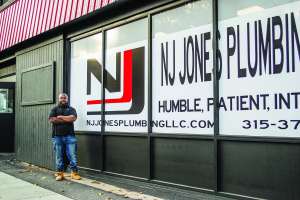
Jones also points to three core values that define his business philosophy: humility, patience and integrity.
“I’m all of those things,” he says. “Emphasizing those three things has kept me in business.”
Jones also credits a career guardian angel of sorts: Rickey Brown, the owner of Diversify-NY, a consulting firm that specializes in helping companies get certified as minority- and women-owned businesses enterprises. Jones met Brown while working for a local home renovation and construction company in Syracuse that needed minority-owned companies to participate in building projects.
“Rickey was my marketing guy,” Jones says. “He helped me get my MBE certification and put my name out there a lot.”
DESTINED FOR THE TRADES
In retrospect, it’s no surprise that Jones ended up in the trades. As a child, he loved to break things and put them back together, he says.
“My mother said I’ll either end up in construction or destruction,” Jones quips. “I also like to work with my hands — create things and see things get done. I also took some automotive classes in high school.”
After landing in jail, Jones earned a GED degree and also took the building trades class, which included basic plumbing instruction.
“You could say that plumbing sort of fell into my lap,” he notes.
During an ensuing internship with a local, nonprofit community construction organization, a plumber at a local company was impressed enough by Jones’ skills and work ethic to hire him. Later, he also worked at several other plumbing companies before getting a master plumber’s license — his ticket to opening his own company.
“I’d always wanted to open some kind of business,” says Jones, who dabbled in promoting concerts and also ran a barber shop for a while. “Once I got my master plumbing license, I knew I’d start my own business.”
TOO BIG, TOO SOON
Growth occurred fairly quickly, fueled by the MBE certification. MBEs get access to a database of opportunities to work as subcontractors for companies that need MBEs to fulfill contract requirements, he says.
“Plus I was a good plumber and was willing to work hard,” Jones adds.
After five years in business, Jones had about five employees and felt fairly well established.
“I got to a point where I wasn’t always worrying about when the next would come along,” he says.
But the entrepreneur learned a valuable lesson around 2021, when the company employed 25 to 30 people and racked up around $3.4 million in sales — but still lost money. At one point, the company was working on three school remodeling projects, three 50-unit apartment complexes (a mix of remodeling and new construction work) and about two dozen home-remodeling projects, he says.
“I tried to take on anything that got thrown at me, but I choked on it,” Jones explains. “It didn’t kill me, but it definitely hurt. There was so much going on that it was hard to keep track of money.”
Then the pandemic hit and prices for materials skyrocketed because of supply-chain disruptions. The prices for materials weren’t locked in with his suppliers, so profit margins on projects took a big hit.
“I also had to take on less skilled laborers to handle all the work, so quality suffered too,” he adds.
There was another actor at work: As the area’s first minority plumber, Jones says he felt obligated to build a big company that could bring in minority employees that he could teach and train, which would benefit both them and the company.
“But that just didn’t work out at all,” he says. “Everybody wants a job until they have to get up in the morning.”
The takeaway? “Stay small,” Jones says. “It’s just not worth it to be big. There’s simply not enough skilled labor to grow.”
EQUIPPED TO WORK
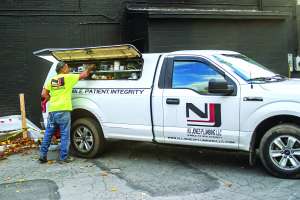
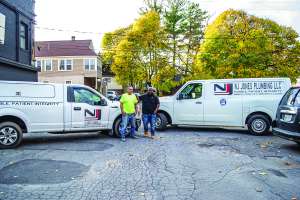
The company owns four service vehicles: two Ford F-150 pickup trucks and two Nissan NV 2500 cargo vans.
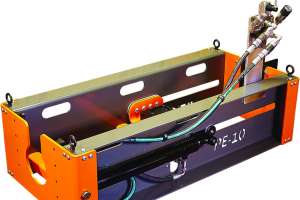
To handle small drain-cleaning jobs, the company owns Model C sectional cable machines from Electric Eel Mfg.; a drum cable machine from Spartan Tool; a J-3055 waterjetting machine (3,000 psi at up to 5.5 gpm) from General Pipe Cleaners (a division of General Wire Spring Co.); and General Pipe Power-Vee handheld drain machines.
The company also invested in a RIDGID SeaSnake microReel pipeline-inspection camera and a M12 M-Spector Flex inspection camera from Milwaukee Tool. For power tools, Jones prefers Milwaukee Tool, DeWalt, Kobalt, RIDGID and Bosch, plus concrete saws from Husqvarna.
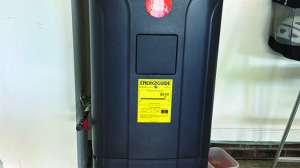
In addition, Jones prefers fixtures from Moen, water heaters from A.O. Smith, tankless water heaters from Navien and toilets made by Mansfield, Sloan Valve Co., American Standard and Kohler Corp.
To improve efficiency, Jones also relies on estimating software from McCormick that has dramatically reduced the amount of time he spends on developing job estimates.
MORE DEMAND FOR CONSTRUCTION WORK
While many plumbers prefer to do service and repair work instead of new construction or remodeling, Jones has always leaned toward the latter because of a simple factor: supply and demand.
“Almost every plumbing company around here has a service department,” he explains. “Yes, doing plumbing for new construction can be cutthroat because of all the lowballing, but that’s only if a lot of people are doing it.
“There’s a lot of construction going on around here and not enough people doing it, so it’s not as cutthroat,” Jones continues. “I even get calls from customers in New York City and all parts of New York state as well as New Jersey and Pennsylvania.”
Moreover, Jones prefers a business model that relies on a steady stream of large, long-term construction projects as opposed to one based on keeping the phone ringing every day for service calls.
“Overall, trying to keep finding work and dealing with customers is just too much of a headache,” he notes.
PLANS FOR THE FUTURE
As he takes stock of his career, Jones says he has no regrets, especially given how plumbing helped him turn his life around.
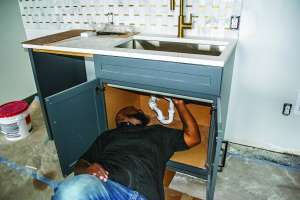
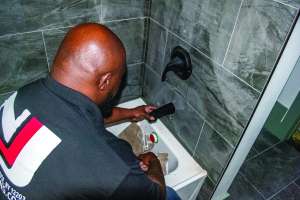
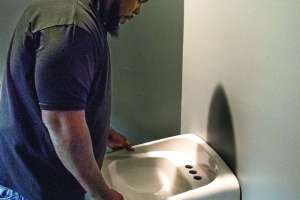
“It’s very fulfilling to see projects get done,” he says, noting that the company currently is working on plumbing 16 newly built, slab-on-grade duplexes. “Seeing stuff get done — that progression from where things start to where they end up — is definitely very gratifying.”
Looking ahead, Jones says he’d like to see more growth, but is hampered by the overall lack of skilled technicians. And given his previous bad experience with rapid growth, any business expansion would have to be carefully managed to avoid decreases in service and work quality.
Jones also says he’s interested in eventually adding a full-fledged service department to complement the construction/remodeling work, especially since he frequently gets calls from customers looking for service and repairs. But again, that would require having the right people on board, he says.
“I just can’t find reliable, skilled labor,” Jones says. “But in the next five years, I still hope to establish a service department.
“In the meanwhile, I’m content with what I have.”