
Entry into new markets can be a big help in driving growth. Take Prodigy Plumbing of Long Beach, California. Founded in 2010, the company started doing pipe lining in 2017 when owner Mark Ellefson grew frustrated with using subcontractors for the service.
“Subs could never get to a job as quickly as we needed them to,” he says. “Furthermore, I want to have complete control over the services we provide for our customers to ensure quality.
“Plus, when you hire subcontractors, you’re leaving money on the table.”
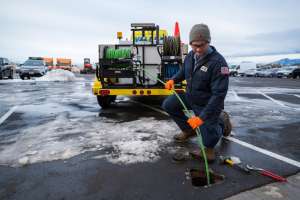
Ellefson invested in a pipe lining system from MaxLiner USA, which uses hot-water-cured felt liners. On average, he estimates the company installs about 15,000 feet of liner a year, mostly in residential sewer laterals.
“We shoot about three liners a week,” he says. “We do 100-foot runs, on average.”
Employees learned the ropes by shooting sample liners in pipes set up in the company’s warehouse. Ellefson still remembers his first job out in the field: a 45-foot-long, 4-inch-diameter residential, clay pipe lateral line with separated pipe sections and tree-root intrusions.
“It was one of the scariest times of my life,” Ellefson recalls. “The cure time was pretty short back then, so you had to install liners quickly before they cured on you.
“But we grabbed it by the horns and ran with it. My hands were shaking and my heart was jumping out of my throat.”
Shortly after that, Ellefson met Jose Flores, a very proficient and experienced MaxLiner installer. It took two years, but Ellefson finally convinced Flores to come on board.
“He’s very well known in the industry because of his social media exposure,” Ellefson says. “Having him on board was a real game-changer. He’s done the most technical and complex lining job ever with zero failures during the past few years. As a result, we’re now very confident installers.”
A job that immediately comes to mind for Ellefson was a pipe lining project the company performed about two years ago.
A 10-store strip mall in Anaheim had a deteriorating 300-foot-long sanitary sewer line that ran under the stores’ concrete-slab floors. To make the job even more complicated, there were about two dozen tie-ins for sinks, toilets and the like — and no clean-outs for easier access, Ellefson says.
“The owner didn’t want to excavate to replace the entire lateral because that would have been a nightmare,” he says. “And the sewer line was one of the worst I’ve ever seen, with rotted bottoms and massive cracks and corrosion, not to mention all the reinstatements that would be needed at the tie-ins.
“The owner kept calling other companies, but no one was interested; they wouldn’t even provide a price. But we love a good challenge, so we decided to figure out how to line this really bad, 4-inch-diameter cast iron pipe.”
A camera inspection revealed that two sections of the pipe were so rotted out that pipe lining wasn’t even an option. So the Prodigy crew had to bust open two holes — one in each of two stores — to manually replace two sections of pipe.
Technicians then used those two holes as access points to shoot hot-water-cured felt liners from MaxLiner USA, using a MaxLiner inversion system.
To avoid totally disrupting the businesses in the strip mall, all the work was performed at night. Technicians used Midi and Maxi Miller drain machines from Picote Solutions to reinstate the tie-ins and a Quik-Coating System from Pipe Lining Supply to restore the original cast iron pipe.
The project took about a week to complete, Ellefson says.
Continue reading for free