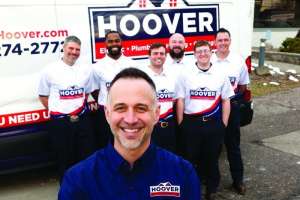
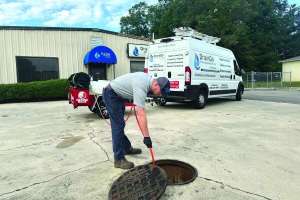
Marcus Piwonski, co-owner of Hoover Electric, Plumbing, Heating & Cooling in Troy, Michigan, with some of his employees at the business. One thing that Hoover is known for is using a trenchless system that allows them to not have to dig up a lawn or go under a street to reinstall or repair a sewer line.
When Gary Hoover established Hoover Electric back in 1980, the company only did new-construction electrical work.
But in the ensuing decades, the company — now owned by Hoover’s sons-in-law, Marcus Piwonski and Matt Hedges — has completely reinvented itself, as evidenced by its current name: Hoover Electric, Plumbing, Heating & Cooling. Plumbing, sewer and drain cleaning services are the backbone of the company, based in Troy, a far northern suburb of Detroit. And electrical work now brings up the rear.
“It’s pretty crazy how we started out in electric and now it’s the smallest division in our company,” says Piwonski, who joined the company in 2005. He and Hedges bought the company in fall 2023.
Plumbing-related revenue now contributes about 40% of overall revenues, while electrical work generates about 20%, he says.
Hoover’s story illustrates the benefits of offering a diverse array of services that provide a one-stop shop for customers, who generally prefer to deal with one contractor instead of multiple contractors. It also underscores the importance of flexibly adopting new strategies as business conditions evolve.
As an example, Piwonski cites the company’s decision around 2008 to add residential electric, due to increasingly longer wait times to get paid by new-construction contractors. Residential customers pay significantly faster, which substantially improves cash flow, he says.
“Working on a time-and-materials basis is a tough way to do business,” Piwonski says. “You often don’t collect payment from contractors for 90 days. And instead of dealing directly with decision-makers like homeowners, you meet with certain (lower-level) managers, make a repair and leave. That gives you no opportunities to grow your service tickets.”
In 2011, the company evolved further by opening a plumbing and drain cleaning division for residential customers.
“We saw that there was much more demand for plumbing, sewer and drain work than electrical work,” Piwonski explains. “Plus whenever we’d go to conferences, it seemed like electrical contractors were always struggling while plumbing, sewer and drain contractors seemed to be making it.
“There’s more breakage, too,” he adds. “You do electrical work and you’re usually done for a long time. But in plumbing, things like water heaters and plumbing and sewer systems break down and the repairs are larger and cost more to make.”
Starting the division from scratch was a huge challenge, Piwonski says. It involved building a customer base, initiating direct mail marketing campaigns, developing a presence on the internet, buying equipment and hiring technicians.
Around 2015, a game-changing event occurred: Hoover was hired as a plumbing subcontractor for a property management firm that did work for 37 Home Depot stores in the Detroit metro area. Hoover primarily installed water heaters — sometimes up to 30 a day — for people who bought them at Home Depot.
“That was our big chance,” Piwonski says. “Before that, we were struggling. But after that, things really started picking up for us.”
Bolstered by the Home Depot work, plumbing and drain revenue roughly doubled. The company used the money to further build a customer base through more mass mailings, radio and TV ads and digital marketing, he says.
Furthermore, installing residential water heaters provided a chance for Hoover to introduce its plumbing and drain services to even more potential customers. The Home Depot work also prompted the company to go all-in on only residential plumbing and drain work, he says.
“We were incredibly busy hiring people, doing background checks, buying trucks and obtaining licenses for our plumbers,” Piwonski recalls. “It was an absolutely insane time — just crazy.”
By about 2017, aided by ServiceTitan business management software, the company finally had the necessary employees, systems and processes in place, putting it on firm footing. Hoover decided to stop doing the Home Depot work in summer 2020.
“We couldn’t handle the stress anymore — it was too much,” Piwonski says. “We had too many plumbers committed to doing this low-margin work, which prevented them from doing higher-margin work. And we had technicians on call six or seven days a week, not to mention we had to carry a large inventory of water heaters, constantly pull permits for installing them and chase customers to arrange for inspections by local municipalities. It involved a lot of logistics.”
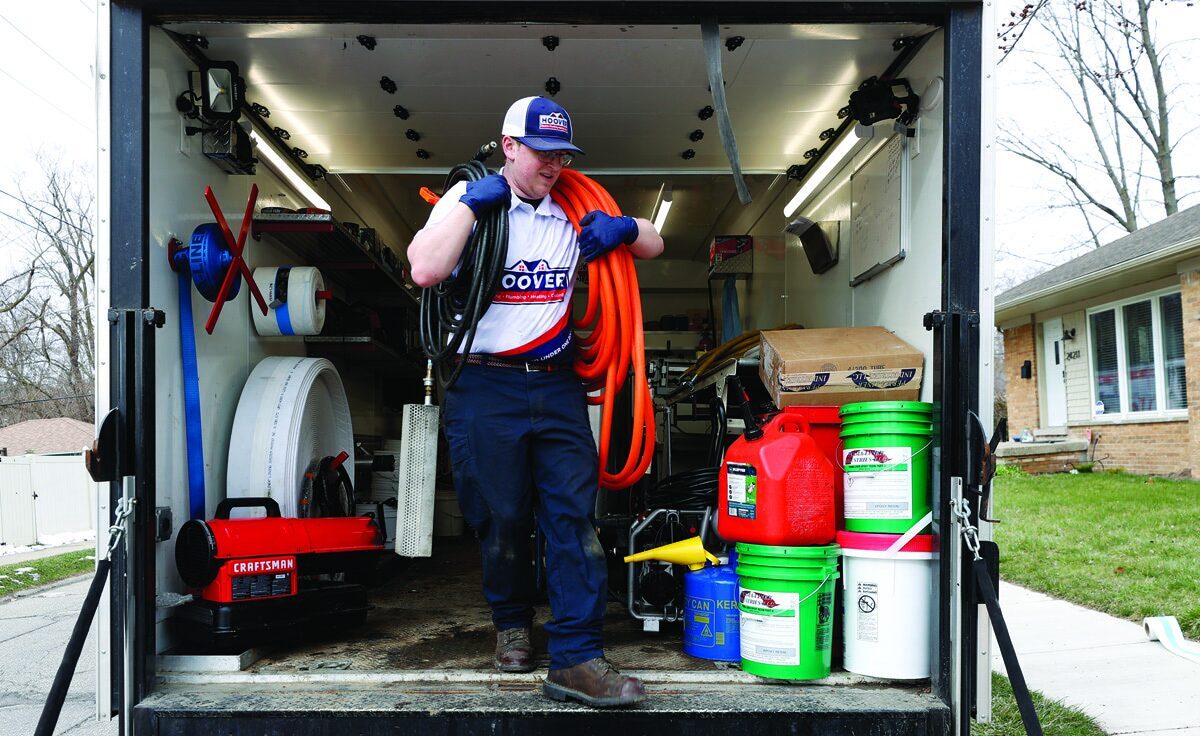
As the company grew (it added HVAC services in 2015), so did its fleet of vehicles and equipment. Hoover now owns 52 service vehicles, including Ford and Chevrolet box trucks, Ford Transits, Dodge ProMasters and Isuzu box trucks. Most of the box bodies are made by Supreme Corp. (a company owned by Wabash National Corp.) and Morgan Truck Body. J&M Commercial Van Outfitting upfitted the service vans with storage systems.
For drain cleaning, the company primarily relies on Spartan Tool 100 and 300 drum cable machines; a Maxi Miller milling machine from Picote Solutions; and a Raptor robotic cutter/reinstatement machine from American Pipelining Supplies.
To inspect pipelines, Hoover owns a variety of SeeSnake pipeline inspection camera models from RIDGID and M18 series inspection cameras from Milwaukee Tool. It also owns an M12 pipeline locator from Milwaukee and NaviTrak Scout pipe locators from RIDGID.
The company has invested in Soldier and Warrior trailer-mounted water jetters from Spartan Tool (3,000 psi at 12 gpm and 4,000 psi at 18 gpm, respectively) and has another Warrior on order.
Hoover also does pipe lining with a steam-cured system from Perma-Liner Industries and a hot-water-cured system from American Pipelining Supplies. It has an LED-based UV SpeedyLight+ pipe lining system on order from Pipeline Renewal Technologies.
“Pipe lining has been a game-changer for us,” Piwonski says. “I see a very bright future in pipe lining.”
Hoover is sharply focused on developing its trenchless work. That was a struggle for a while, but a recent hire, Korey Covington, who now manages the trenchless division, has turned things around. A two-person pipe lining crew currently averages about four jobs a week, and Piwonski expects to establish another crew within about six months and raise production to eight pipe lining projects per week.
Investments in reliable and productivity-enhancing equipment have played a key role in growing the company’s plumbing and drain division. But zeroing in on hiring the right people to operate the equipment has been just as important.
There was a time during Hoover’s go-go growth years when there was little due diligence done when hiring.
“For many years, we were so desperate that if you were a plumber, we’d hire you,” Piwonski says. “Now we’re a lot more careful and hiring the right people has made a night-and-day difference.”
How big a difference? By late spring of this year, the company generated about $4.6 million in sales, compared to about $2.3 million in sales during the same period in 2023.
“I’m very confident we can attribute that growth to one thing: the good people we were able to bring onto our team,” Piwonski says. “Our job leads are only a little higher this year than last year for the same time period, so the only real difference is the people.”
Those key hires include an HVAC salesperson who, in turn, referred two technicians to Piwonski; a drain technician that also referred another technician who also referred yet another technician; and a plumbing manager.
“They’re all amazing people,” he says. “I just stay out of the way and let them do what they need to do. People love that management style. I had one employee say he never believed there was a business that runs like ours.”
QUALITY COUNTS
A commitment to doing quality work also has been crucial to Hoover’s growth. Piwonski says it’s a big differentiator in the company’s market.
“That means when things go wrong, we stand behind our work 100%,” he says. “And our people know it. If you’re not going to do good work, it’s not going to fly here. That’s a strong part of our culture and it has allowed us to build a really great team. We’ve been very blessed.”
Piwonski notes that anyone can market a company — come up with a cool name, create a great logo and buy ad space.
“That’s the easy part,” he says. “But how you deliver your services and get people to call you back — that’s the hard part. But good people help you do that.”
To demonstrate its commitment to quality work, the company has a 100% customer satisfaction guarantee and doesn’t charge anything if a technician can’t repair something, Piwonski says.
Why establish policies like this?
“It keeps us in check, motivates technicians to do thorough evaluations,” he explains. “If we don’t do a proper evaluation and don’t provide options that fix a problem, then we’ve failed and that’s on us, not the customers. It’s just the right thing to do for our customers.”
Have those guarantees ever come into play?
“Absolutely,” Piwonski says. “But situations like that usually stem from a poor evaluation. It’s not rocket science. A proper evaluation should prevent problems from happening. And if we don’t do a proper evaluation, we need to eat it, as well as evaluate why it happened. It’s a self-policing policy because no technician wants to fail, so they usually take enough time to do a thorough evaluation. Our culture promotes doing the right thing every day.”
As Piwonski looks ahead to the next five years or so, he has high hopes for the company.
“If we stay on the same trajectory, I foresee us doubling our business,” he says. “I think we can become one of the Detroit metro area’s largest home services providers. And with the right people, I think that’s very doable.”