“Sometimes it’s helpful to have an outside perspective — come in from the business side and not know anything about plumbing,” says Couper. “Usually the two worlds of business and plumbing don’t combine very well, but we’ve morphed the two together.
“I know it sounds counterintuitive — someone with a finance background and no plumbing experience buys a plumbing business,” he adds. “But it’s working out great.”
The name of the corporation Couper established to buy the company, Baby Blue Plumbing Inc., reflects the merger of the two disciplines, he says.
“When you combine blue collar with white collar, you get baby blue, as well as the best of both worlds,” he explains. “And being a business guy who doesn’t do plumbing frees me up to keep looking at the big picture.”
Couper attributes the large year-to-year revenue leap to better systems and processes coupled with a great management team and his business, marketing, finance and leadership skills.
“My goal was to take something outdated with a good bone structure, modernize it and compete in that space,” he says while explaining his drastic career U-turn from finance to plumbing. “But it’s not just about me — it’s also about improving the lives of employees.
“There are too many companies in the blue-collar space that pay their employees bare minimum and then reap the profits,” Couper says. “But I saw an opportunity to change that — create an environment that would be hard for other companies to compete against.
“You only have one life to live, so you might as well enjoy it and challenge yourself.”
ABRUPT CAREER CHANGE
Couper had spent 13 years in the personal wealth-management field after earning a degree in finance and entrepreneurship. He was about to open his own finance company, but then decided a career shake-up was in order.
“I was bored, as well as sick of the corporate red tape that kills your entrepreneurial spirit,” Couper recalls. “It’s really hard to be innovative and entrepreneurial in the financial space. It got to the point where I didn’t want to get out of bed in the morning to go to work.”
At first, the 37-year-old entrepreneur considered buying a franchise. But then he switched gears and focused on acquiring a company. Plumbing seemed like a good option because it’s essentially a recessionproof industry, he says.
Kyle Plumbing, which was for sale because the owner was retiring, was the 20th company Couper considered buying. The business checked off a lot of boxes: a good location, the right number of employees (about 25), a great culture and reputation, solid revenue generation and outdated processes and systems.
“Everything was done with paper,” Couper says. “The customer-relations management system that kept track of customers’ names and addresses was outdated and there were no coordinated systems internally.
“Technicians typed up invoices in their trucks on laptops bolted to the passenger seat and printed them out on a printer set on the center console,” he continues. “There was no price book or inventory management system, so you couldn’t tell what was on the trucks or in the warehouse.
“But the owner still was very successful,” Couper adds. “Part of the appeal was the chance to make an immediate impact.”
PUSH FOR BETTER EFFICIENCY, PROFITABILITY
One of the first things Couper did to modernize the business was subscribe to ServiceTitan, a business-management software that handles everything from dispatching, financial reporting and job scheduling to customer payments, payroll and job estimates.
Couper also steered the company toward more service plumbing work and less new-construction plumbing, to the point where construction-related work now generates about 50% of the company’s revenue, compared to 70% before. Couper wants to eventually reduce it to 30%.
Why make this switch? Residential work generates better cash flow, he says.
“When I bought the company, I didn’t have the best understanding of how construction plumbing worked,” he notes. “I found it pretty crazy that you can do a $300,000 job and not get the first payment for 30 to 45 days or more.
“I have huge issues with tedious and time-consuming red tape, so we re-evaluated our business relationships with contractors we had inherited and created new relationships with contractors that have more fair billing processes.”
Couper also implemented a flat-rate pricing system, using a software product called Profit Rhino, and invested in an inventory-management software platform from Ply Financial.
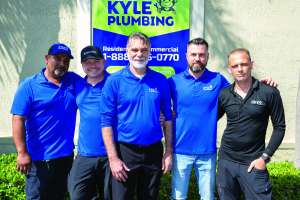
Changes to the company’s management structure also helped drive growth. Couper now has one general manager who handles the service side of the business and another one that manages the new plumbing construction side of the business, while he manages the overall business.
Couper also hired a human resources/culture manager and divided up field supervision duties for new construction between two field supervisors.
“It’s provided tremendous benefits,” he says of the reorganization. “It gives me the time to stay on top of things better and be tuned in to what’s going on company-wide.”
These redefined roles also help to minimize what Couper calls “job-creep,” where employees keep assuming more and more responsibilities, which leads to frustration and confusion.
RELIEVING EMPLOYEE CONCERNS
Couper says he also took steps to counter employee fears about layoffs. He accomplished this through one-on-one meetings with employees that helped him get to know them, build better relationships and learn what changes they’d like to see.
Because some of the requested changes would take time to implement, Couper made sure to “pick their brains” about little things that could be accomplished quickly. Picking this proverbial low-hanging fruit helped build trust early on because employees could see results quickly, he explains.
For example, some technicians wanted better-quality uniforms made from a more breathable material, which was accomplished fairly quickly and easily, he says.
Just about every employee also received a pay raise, determined by market research on prevailing wages.
“Before, for example, everyone on the construction side got a one-dollar-per-hour raise once every year, which isn’t good,” he says. “We also made them eligible for performance bonuses, which gives them more motivation to work harder and make fewer mistakes.”
Furthermore, employees now are eligible for raises every time they master a certain set of skills. This helps to boost employee-retention efforts because people are less inclined to leave the company for a job that perhaps pays $2 or $3 more an hour, he notes.
DIFFERENT CUSTOMER APPROACH
On the plumbing service end of the business, technicians now get commissions if they hit certain revenue thresholds. But there are no sales quotes to meet, Couper says.
Couper also implemented a new sales process for technicians in which they look for other plumbing issues along with whatever problem they came to fix.
“We don’t want them to just fix the symptoms,” Couper explains. “We want them to also try to cure everything else at one time, as opposed to fixing a broken toilet and then just leaving.
“We at least want them to have a conversation with customers and build relationships,” he continues. “Customers tend to like that because they like to know about problems ahead of time. And if something goes wrong later on, you at least can say you pointed it out as a potential problem.
“I just think it’s the right thing to do.”
Couper recognizes that there’s a thin line between informing customers about recommended service and high-pressure sales tactics. As such, technicians are instructed to present three different options — a good, better and best approach — as well as educate customers about all recommendations so they have some context for making informed decisions, he says.
“We avoid cheesy, high-pressure sales tactics and canned presentations,” he says. “We treat every customer like they’re a family member.
“You can use a commission-based structure without being a scumbag.”
EMPHASIS ON TRAINING, EQUIPMENT
The company also emphasizes ongoing training, which serves as a great tool for both attracting and retaining technicians. For instance, technicians recently received training from Rinnai for working on tankless water heaters and the company also creates its own training modules to strengthen technicians’ skills where needed, Couper says.
“We pay them for the time they spend in training,” he notes. “We’re constantly keeping them attuned to new technology and products. Training is a big piece of the retention puzzle, along with good pay and work/life balance.”
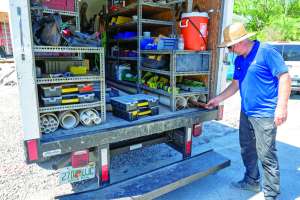
Good equipment also serves as an employee-retention tool. On the service side, the company owns six vehicles: four Ford Transits and two Ford Maverick pickup trucks. Advanced Work Vans outfitted the trucks with Adrian Steel storage systems.
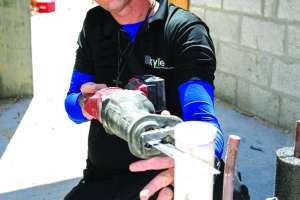
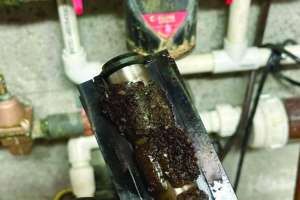
The company also has invested in drain machines from RIDGID and Milwaukee Tool; water jetters custom-built by Proline Equipment; leak detection systems and pipeline inspection cameras from RIDGID and Milwaukee Tool; a Gen-Ear LE water-leak detection system from General Pipe Cleaners (a division of General Wire Spring Co.); and a One Edge Pro thermal camera from Teledyne FLIR.
In addition, the company also relies on HALO water filtration products and systems; Moen, Kohler and TOTO toilets and fixtures; Rheem and A. O. Smith water heaters; ACO drains for commercial customers; Rinnai and Navien tankless water heaters; and backflow-prevention parts from Watts and Zurn Wilkins.
OPTIMISTIC OUTLOOK
Looking ahead, Couper expects continued growth, but in a manageable way. One growth avenue could be acquisitions of other plumbing companies and another could include opening more facilities in various cities in Florida.
“We’re not going to grow just to grow,” he says. “It has to make sense.”
Looking back, Couper says he has no regrets about his decision to trade in mutual funds for monkey wrenches.
“I’m very, very happy,” he says. “I took a 60% pay cut to buy and run a plumbing business, but it was worth it to do something you enjoy every day.
“I put in long hours but it never feels like work,” Couper continues. “I like problem-solving, creating things and competing — and I get all of that with this business. Plus, I get to make our employees’ lives better, too.
“It’s definitely a win-win situation.”