Dave Banghart searches for leaks in a wall at a customer’s home. The camera can detect
hot and cold in the walls to pinpoint leaks.


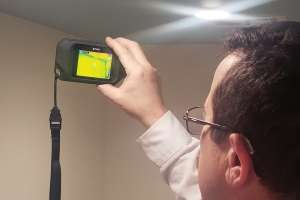
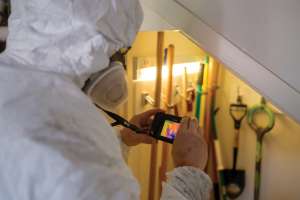
Dave Banghart searches for leaks in a wall at a customer’s home. The camera can detect
hot and cold in the walls to pinpoint leaks.
When Dave Banghart arrived at a five-story-tall apartment complex last summer to help a maintenance worker find what he called an “elusive” leak, the owner of Banghart Plumbing wasn’t worried. The reason for his confidence? A FLIR Systems C2 Lowepro thermal-imaging camera.
“He took me into an underground parking garage and showed us a sewage leak in the ceiling,” Banghart recalls. “I looked around with the camera and could tell we were below a tenant’s bathroom.” So Banghart asked the maintenance worker to let him into the first-floor apartment above the leak, where another look with the camera revealed a floor-to-ceiling bluish pattern — the color that indicates the presence of water.
“Then we went up to the second floor to see if the pattern continued or stopped, which would indicate the leak was confined to just the first-floor apartment,” Banghart explains. “But we found the same pattern.” So Banghart asked the worker to let him into the apartment above, on the third floor. Same story. When Banghart asked for permission to get into the next apartment up, on the fourth floor, the worker objected a bit, noting there’d never been any sewage-leak issues that high in the building. “He was sure we were following the wrong path,” Banghart says. But finally, the worker reluctantly agreed after Banghart made a persuasive pitch for the camera’s abilities.
“A look at the wall in the fourth-floor apartment showed just a patch of blue at chest level,” Banghart says. “The maintenance guy was incredulous — he couldn’t believe it. I said, ‘Let’s just open it up and take a look at it.’ We found a separated waste fitting on a pipe coming down from a fifth-floor apartment. He was blown away.”
The process took a little more than an hour. “And it only took that long because it took a while to convince him to let me into the fourth-floor apartment,” Banghart says. “But in the end, he was pretty happy. Without that camera, we would’ve had to open up test holes on every floor, which would’ve been very disruptive to tenants, time-consuming and expensive.”
This case exemplifies the value of the FLIR Systems camera, which has greatly increased the efficiency and revenue of Banghart’s one-man service and repair plumbing shop, based in Everett, Washington. As he puts it, better productivity naturally leads to better profitability. “When you go on a leak search, you have to plan on setting aside a lot of time, especially for those ‘elusive’ leaks,” he explains. “But now, I set less time aside because I’m confident we’ll find leaks quickly. And that, in turn, opens up my schedule to take on more work.”
A GAME-CHANGER
Before he invested in the camera, Banghart relied on the traditional approach to tracking down the source of leaks: dead reckoning and triangulation, followed by opening up holes in ceilings or walls, for example, and trying to follow the water’s trail. “Pretty soon, you’ve opened up more holes than you really wanted to, but there’s no good way to avoid it,” he points out. “But with the FLIR, you just point it at a ceiling and you can see the trail of water making its way across the ceiling. You can even see where the joists are located. I’d say we usually can find a leak within minutes, rather than hours.”
The camera doesn’t actually detect water; instead, it detects heat signatures represented by an array of colors. If water is cooler than its surroundings, it appears on the camera screen as a blue or dark-blue area. If it’s warmer than its surroundings, it appears as a light-orange area, he says. “It’s basically detecting heat differentials between surfaces,” he explains.
Banghart says that after the first time he used the FLIR Systems camera and quickly found the source of a bathroom leak, he knew it would be a game-changer for his business. “If it took two minutes, I’d be surprised,” he notes. “I knew I wasn’t going to have to use conventional leak-detection methods anymore.”
EASY TO USE TECHNOLOGY
The camera is easy to use and offers customer-centric amenities such as a built-in thumb drive on which the user can store images. That comes in handy for insurance claims. “Or we can email images to a customer if they weren’t able to be home when we come over for a service call,” he says.
Banghart says he paid about $700 for the camera. “And it paid for itself in the first week — and keeps on paying for itself,” he adds. “Since we use flat-rate pricing, finding leaks faster puts dollars in my pocket.
“This is a great example of why you have to keep up with technology,” he continues. “If you’re the guy who’s still opening up walls to find leaks while someone else doesn’t because they’re using a thermal-imaging camera, they’ve got an advantage. Say you’re not available and a customer instead uses a new plumber that owns one of these thermal-imaging cameras. If he finds that leak in 15 minutes, you’ve just lost that customer.”
In the meantime, Banghart — who runs a 2016 Chevrolet Savannah cutaway truck with a 12-foot box body made by the Heiser Body — says he plans to buy another FLIR Systems camera that offers even more capabilities. “I just want to keep staying ahead of the technology curve,” he says.
Continue reading for free