In Part I of this three-part article, I outlined the staggering number of Americans who live without safe water and sanitation. That number is more than 2 million and includes men, women and children here, today, in the United States. In Part II, I explained the challenges that one area of the U.S., Lowndes County, Alabama, is facing due to soil conditions which are not favorable for traditional septic systems and how the poverty rate there is forcing the residents to use “straight-pipe” systems to discharge their wastewater.
In this final article, I’m going to give you an overview of how my International Water, Sanitation, and Hygiene Foundation Team and our partners are working together to address these systems in Lowndes, and provide safe and sanitary plumbing systems.
Hundreds, yes, hundreds of homes in Lowndes County are in dire need of new or rehabilitated septic systems. The soil type, known as Black Prairie soil, is virtually nonabsorbent and as I mentioned, does not play well with conventional type septic systems. As with almost all these types of sanitation projects, the key to addressing the problem is finding the funding to do it, acquiring the plumbing products for the repairs and replacements, attaining the qualified/licensed professionals to install it and providing the education to sustain it.
THE FUNDING
In Part II of this series, I mentioned an organization by the name of The Black Belt Unincorporated Wastewater Program. An amazing woman by the name of Sherry Bradley, founded BBUWP. Sherry is the former director of the Bureau of Environmental Services with the Alabama Department of Public Health. She served as a public servant for 45 years and has worked in the field on this project since 2018.
Sherry saw firsthand for almost 20 years the improper wastewater disposal that was occurring in Lowndes County and decided enough was enough. Sherry, along with several others, decided to produce a model onsite program that local officials could follow. It took her three years to do, but she’s nailed it!
BBUWP worked hard to secure a federal grant from the USDA. That grant was originally scheduled to fund 100 homes, which are registered in the program. With some modifications, the grant will now cover upwards of 200 homes. She and her staff continue to work towards securing other grants and donations as well.
The BBUWP program is the first project of its kind where a homeowner pays a one-time down payment of either $500 or $1,000, depending on the soil type and $20 per month for maintenance of the system. What I like about the program is it gives the participants “buy-in.” It makes the system “theirs.” The folks receiving these systems are some of the most humble, hardworking people I have ever met. They weren’t looking for a handout, they just needed some help. BBUWP is doing just that.
INDUSTRY SUPPORT
With the funding falling into place for BBUWP, the need for industry support was up next. It’s here that the Lixil Company, which manufactures American Standard and GROHE brand plumbing products, came to the table.
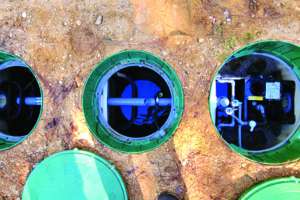
Lixil brought in another company by the name of FujiClean USA, which is a manufacturer of onsite domestic wastewater treatment systems. By utilizing their pretreatment systems, they were able to address the unique soil conditions in Lowndes County. The wastewater that leaves these systems is so clean that the installers can install drip system septics.
The drip distribution system is a type of effluent dispersal that can be used in many types of drain fields. The main advantage of the drip distribution system is that no large mound of soil is needed as the drip laterals are inserted into the top 6 to 12 inches of good soil which is located above the Black Prairie soil.
Next, with FujiClean onboard, Lixil knew that a key component to maintaining a septic system and promoting a long life for it, was to ensure that the minimal amount of effluent possible is discharged to the system from the home. To do that, Lixil donated highly efficient WaterSense plumbing fixtures, faucets and showerheads. This not only puts less stress on the septic systems, but it also assists in lowering the homeowner’s water bill. I’d also like to add that in some cases, it was documented that the water bills declined by almost half!
LABOR SUPPORT AND EDUCATION
Having the funding and manufacturer support, the next part needed was the labor to install everything. FujiClean worked with local septic installers and trained them on the installation of the systems.
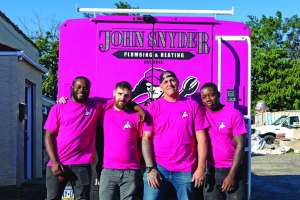
My IWSH team then came in to provide the labor for the interior plumbing work. Now, just to be clear, we do not have a large team. As a matter of fact, there are only three of us on the U.S. based staff. Two of us are plumbers and our director is from the government relations world. Now add into the equation that my co-worker — who is the other plumber on the team — and I both have full-time jobs with the International Association of Plumbing and Mechanical Officialsand there is no way our foundation could take on the hundreds of homes in Lowndes that need repair and upgrades.
So, we did what we do best. We connected with labor unions and associations that represent licensed plumbers and organized a group of volunteers to assist us.
Together we were able to begin the process of making the repairs needed. While the group was still somewhat small, the impact we made was huge. This opportunity to work side by side with these professionals allowed us to also work on putting the spotlight on the shortage of skilled labor and, at the same time, bring in contractors who were not aware of BBUWP’s efforts or needs for licensed plumbers. This set the stage for an opportunity for both parties to look at potentially contracting together and continuing the work that needed to be done long after IWSH left.
COMMUNITY INVOLVEMENT
The last piece of the equation that IWSH felt it could assist with was pulling in more community involvement to assist with the plumbing issues. I’m sure you’ve heard the phrase “it takes a village to raise a child.” If you Google it, you’ll find its meaning to be that it takes many people (“the village”) to provide a safe, healthy environment for children, where children are given the security they need to develop and flourish, and to be able to realize their hopes and dreams.
What if we twist that phrase around a bit: “it takes the children of the village to raise the village.” Think about it like this; “To provide a safe, healthy environment for the village, where the village is secure, the children need to continue to develop it, so it flourishes and hopes and dreams come true.”
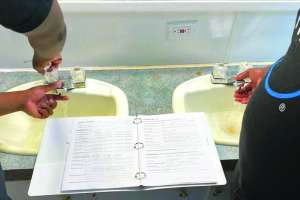
The way in which we did this was by developing a home plumbing survey. This survey provides a comprehensive view of the home’s interior plumbing. It identifies flow rates of faucets, water consumption of fixtures and fixture counts. It also establishes the condition of the fixtures, valves, faucets and appliances. Overall, it provides enough information to create a job sheet for each home which needs repairs or updates. These job sheets can then be turned over to the contractors for bids or quotes. They also serve as a resource to track the repairs and the improvements being made across the community.
We then worked with local high school students and trained them on how to perform the survey and gave them a Plumbing 101 lesson at the same time. The training included classroom and hands on home surveys where we walked through homes with the students explaining how the survey worked and enforcing the method of filling it out. It also gave the students an opportunity to ask “on the job” type questions. What was cool about the training was that it served two needs. As I mentioned above, it created job sheets for the homes and second, it gave these students an introduction to the plumbing field.
The training materials we created were turned over to BBUWP and we continue to support it by performing trainer-type classes for new instructors, updating them as needed, and making ourselves available for any questions the trainers or students have.
So, as you can see, by working together we “Raised the Village” and assisted in cleaning up one of America’s dirty secrets.
------------
Randy Lorge is a third-generation plumber and the director of workforce training and development for the International Association of Plumbing and Mechanical Officials. Lorge is also a member of the planning team for the International Water, Sanitation and Hygiene Foundation. This 501(c) (3) foundation has completed water and sanitation projects for those less fortunate in India, South Africa, Indonesia and, more recently, the United States. He enjoys time with his family and spending as much time as possible in his deer stand. To contact Lorge, email editor@plumbermag.com.