
PEXa pipe meets needs for energy efficiency and fast installation at new schools
Problem: As more families moved to Victoria, British Columbia, the Sooke School District built two new schools for 1,200 elementary and middle schoolers. Remaining earth-friendly was important, leading the project planners to target LEED v4 Gold certification. To achieve this goal, the planners followed a district heating model, in which a central plant collects and distributes energy between the schools for flexible heating and cooling. According to project engineer Michael Hladky, the key to success in these applications is keeping the heating or cooling energy from escaping while it travels to the schools.
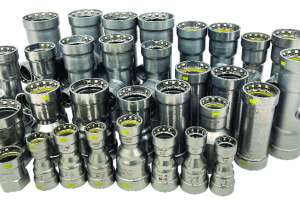
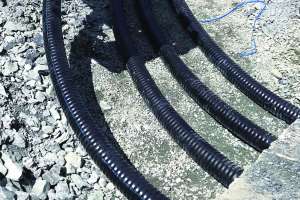
Solution: To meet the challenge, the team specified 2,800 feet of REHAU INSULPEX pre-insulated PEXa piping to deliver energy from the plant to the schools. INSULPEX is designed to efficiently transfer hot or chilled fluid through buried pipelines, minimizing energy loss while supporting labor and material savings.
Result: In the field, installers noticed the durability and user-friendliness of INSULPEX paired with the RAUTOOL hydraulic tool kit. “The system is just bulletproof,” says installer Joe Bell. “You can’t put the pipe and fittings together wrong; the tool won’t let you misposition anything.” INSULPEX further delivered favorable performance results, supporting the schools’ energy targets. 800-247-9445; na.rehau.com
PEX fittings used in cold-climate radiant heating system
Problem: Standard electric heating systems aren’t always enough to combat harsh Canadian winters, so some homeowners turn to hydronic heating for better results. Tibor Schuller, owner of Schuller Hydronics, wanted to model this comfort in his own home and sought a safe and efficient radiant heating system to accomplish the task.
Solution: Schuller Hydronics turned to SharkBite’s oxygen-barrier PEX and EvoPEX fittings for the job. Because PEX is flexible, the team could more easily handle it than rigid pipe, bending and securing it quickly along the floor. EvoPEX fittings, meanwhile, assured that connections were sound and permanent since they display a green indicator when pipe is properly inserted. The Schuller team also used the SharkBite manifold, which has push-to-connect branches that can be disconnected. That way the team could adjust if needed without losing valuable parts.
Result: Because of EvoPEX’s push-to-connect design, the hydronic heating system was quick to install, saving the company about 40% on labor costs. Schuller also considers it more eco-friendly, longer lasting and easier to work with than alternative hydronic heating fittings. This system efficiently warms his 3,200-square-foot home from the basement, throughout the house and out to the porch. 877-700-4242; www.sharkbite.com

Radiant heat answers call in cold environment
Problem: Wyatt Kincheloe, owner of Mountain Man Plumbing in Cody, Wyoming, was hired to provide a heating system for a 3,000-square-foot fabrication shop. With long, bitter Wyoming winters, the owner wanted an in-floor heating system. Kincheloe conducted a heat loss calculation based on the drawings, using a -20 degree F outdoor design temp. Not including DHW load, the building required 140 mBh. “Due to the size of the boiler room, I suggested the use of a combi boiler,” says Kincheloe. “We’re at 5,000 feet above sea level, so that was a consideration when selecting a model. I’d recently heard that U.S. Boiler’s Alta boiler is rated for high elevation, and I wanted to try the new gas-adaptive technology.”
Solution: The Alta combi unit Kincheloe selected provides 200 mBh of DHW capacity and 150 mBh heating capacity. This was Kincheloe’s first time installing an Alta, so he used the startup wizard within the USB-Connect mobile app. The new app, which interfaces with the boiler through a Bluetooth adapter, allows technicians to access the boiler control via smartphone or mobile device rather than the boiler display. “I downloaded the app, plugged in the adapter, and could immediately see and modify all boiler functions on my phone,” said Kincheloe. “I set the slab supply water temperature to 120° F, and set the DHW setpoint to 119° F.”
Result: Even though perimeter insulation wasn’t complete, the owner’s largest gas bill was $300. This came mid-winter, when northwest Wyoming saw a weeklong stretch when daytime temperatures never rose above 0 degrees F. 888-432-8887; www.usboiler.net
Continue reading for free