
Keeping a commercial plumbing project on schedule is no easy task. With so many trades working on the same site, plumbers often face delays caused by poor coordination, supply chain hiccups, or unexpected on‑site challenges.
How can plumbing and mechanical contractors prevent these setbacks and keep commercial plumbing projects on schedule?
Here are four strategies — including real-world product examples — that help contractors stay efficient and on time.
1. Planning and Coordination
Poor planning and scheduling conflicts are among the biggest reasons construction projects are delayed. On large commercial jobs, 20 or more trades might be working simultaneously. Even when plumbers get an early start, site conditions rarely match the original plans.
- Start early: Preparation often begins two to five months before a job starts. Reaching out to suppliers ensures fixtures, rough‑in materials, and specialty finishes are available when needed.
- Communicate clearly: Sharing technical sheets and confirming fixture requirements ahead of time avoids surprises.
- Think big picture: When all trades know how their work connects, conflicts can be solved before they disrupt the schedule.
2. Adaptable and Time-Saving Products
The right products can make the difference between staying on schedule and falling behind. Flexible and adjustable solutions are invaluable for sites where walls aren’t perfectly square or floors aren’t level.
Flexible Bathwaste and Overflow Kits
A bathwaste and overflow kit with flexible and adjustable tubing serves as an alternative to rigid PVC. The kit makes it easier to overcome job-site obstructions such as floor joists, misaligned/offset drains, and severely sloped walls.
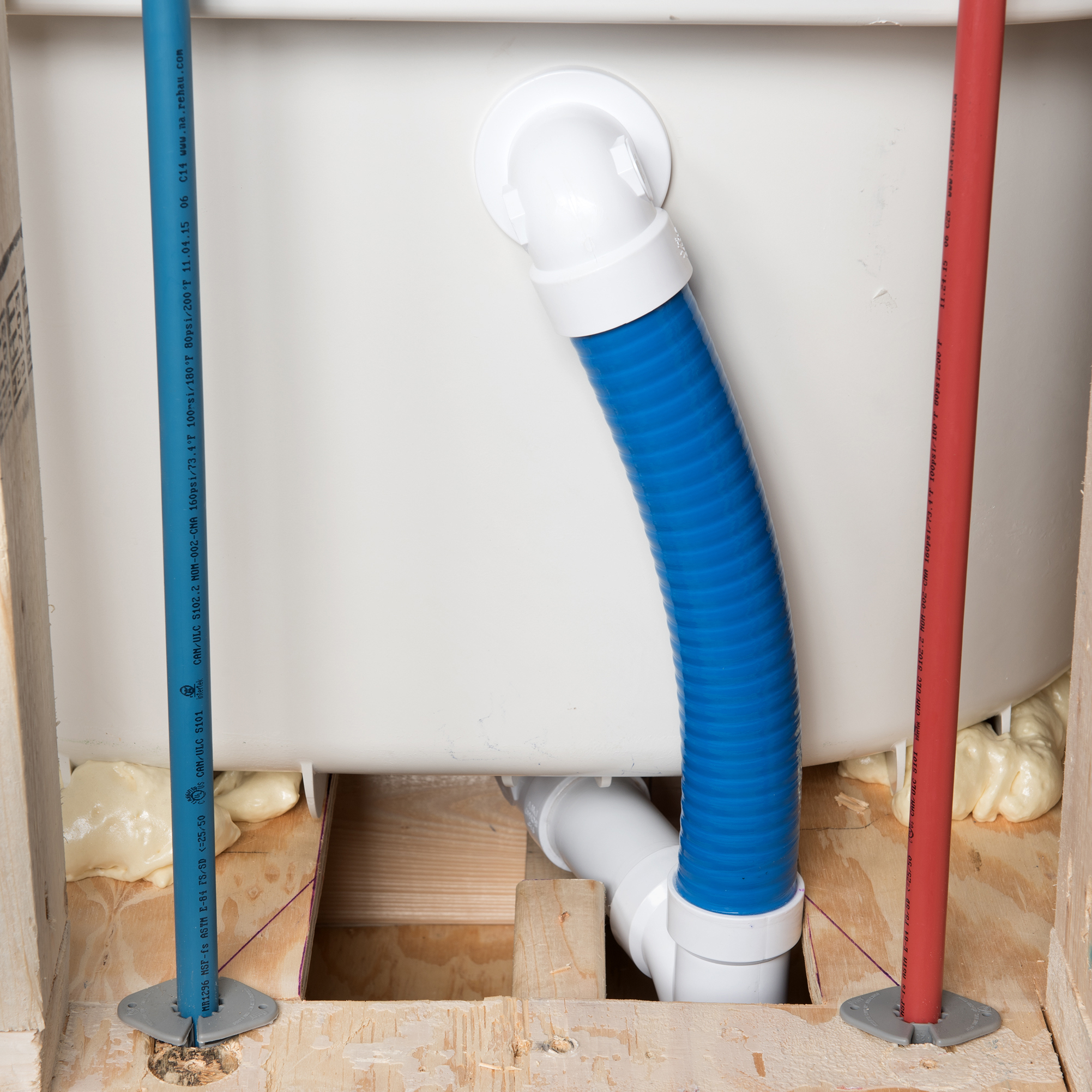
Nick Parlet, owner of Tidy Pipes Plumbing in Rochester, New York, recently faced a tricky drain‑realignment issue. A tub’s P‑trap was offset and misaligned, posing leaks, backups, and water damage risks. In response, he turned to the Dearborn True Blue FLEX Bath Waste Kit, whose flexible tubing and tool‑free locking components allowed for a quick, reliable fix without cutting or realigning piping.
“The flexible pipe allows me to easily navigate obstructions, such as floor joists, without additional fittings or solvent-welded joints,” he explains.
Furthermore, a bath waste and overflow solution that requires no additional tools will help avoid a common job-site challenge involving the installation of overflow covers. Usually, you would have to attach the overflow (on the tub side), using screws and a brass yoke. Dearborn True Blue Bath Waste Kits require only a simple clockwise turn for overflow cover installation.
Plumbing Outlet/Supply Boxes
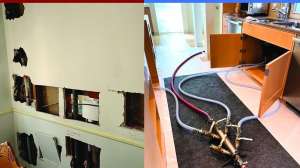
Supply boxes are another solution that saves time by integrating valves directly into the wall for under-sink and toilet installations. At the 27‑story Grand Hyatt Nashville (591 guest rooms), Lee Company leveraged the MODA Supply Box System to eliminate time‑consuming copper stub‑out steps by enabling immediate final hookups after pressure testing.
According to Jesse Whitaker, project superintendent: “Designed to adapt to 3/8-inch supply lines, MODA boxes eliminate the traditional process of stubbing pipes out of the wall, waiting for drywall, cabinets, and fixtures to be installed, then returning to cut and fit valves.”
Installed early in the project and protected with a removable cover until final hookup, the MODA system requires only a simple supply-line connection at the end: No cutting, no escutcheons, and no extra finishing steps.
“After the pressure test, you are immediately ready for the final hookup,” Whitaker says. “Eliminating that middle, stub-out step is a huge, time-saving convenience for any job, especially one the size of the Grand Hyatt.”
These supply box systems are also built for quick installation by offering multiple mounting configurations, including snap-together boxes that can be secured with only two screws. Integrated flanges and angled nail slots support wood and metal framing installation.
Because the boxes are compact and flexible, installers need not cut additional blocking or create custom supports to mount them securely. Each component, from bracket design to valve accessibility, is engineered to reduce friction during installation.
Self-Closing Pipe Supports
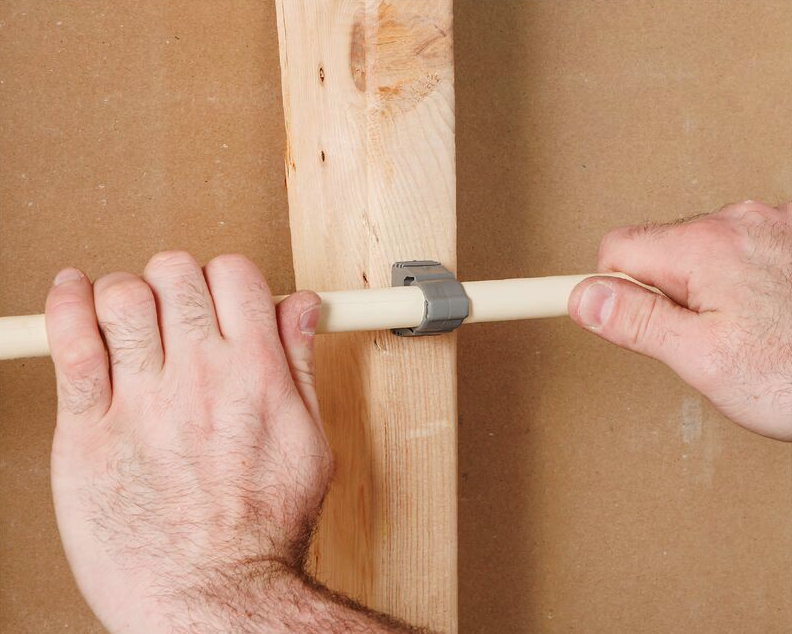
While pipe clamps do the job, they often require two hands when positioning pipe or fastening overhead. This method works, but it’s not always the most efficient.
Self-closing pipe supports can reduce the time required for each installation by several seconds. Those modest incremental savings translate into hours saved on projects requiring thousands of supports.
The installer can snap a support over the pipe with only one hand, holding it in place until it can be secured properly. The interlocking design can be handy when running parallel lines in mechanical rooms or utility chases.
A dual-wall bracket version adds more stability when installing grouped pipes, helping with alignment and overall neatness.
3. Pre-Assembly and Prefabrication
Prefabrication has become a significant time-saver for commercial plumbing. By assembling components off site, plumbers can work ahead of the construction timeline, building complex systems while the project is still in its early phases.
For example, wall-hung toilet carriers, rows of urinal carriers, or shower valve banks can be fully piped, pressure-tested, and labeled before reaching the job site. In some cases, these assemblies are large enough to be craned into position and secured in hours, saving days of on-site labor.
Even smaller-scale pre-assembly, such as cutting all pipe lengths for dozens of shower valves in advance, eliminates repetitive measuring and cutting in the field, reducing both installation time and the risk of error. This approach is particularly valuable on high-density projects like hotels, dormitories, and multi-family buildings.
4. Inspection Efficiency
Inspections often become bottlenecks if not managed strategically. Here are three tips for keeping them from delaying progress:
- Group inspections: Try combining inspection tasks rather than scheduling multiple weekly visits.
- Know the code: Ensure all materials are jurisdiction‑compliant before the inspector arrives.
- Be prepared: Address common inspection checkpoints ahead of time to avoid repeat visits.
A Final Word
Keeping a commercial plumbing project on schedule requires careful planning, clear communication, and the right tools. By combining foresight with efficient practices, plumbing contractors can avoid setbacks while delivering quality results on time.
About the author: Sean Comerford is manager of Inside Sales and Tech Support at Oatey Co. He is a third-generation tradesman with nearly 20 years of plumbing experience, including serving as the lead plumber for commercial/residential new-construction, service and fire protection jobs. He holds a State of Ohio Fire Protection License for Sprinkler and Standpipe.