
Ventilation Power Cleaning has been doing business in the Pacific Northwest for more than a half-century, so it’s safe to say the company knows what nozzles will get the job done. And for about 25 years now, the company’s preferred nozzles have come from KEG Technologies.
“KEG is all we use,” says Bill Benner, senior project manager at Ventilation Power Cleaning. “Once we switched over to KEG, we stuck with them.
“Sometimes with a new truck, we get other nozzles that will come with it. Generally speaking we just take those nozzles and they go to the scrap metal bin because they do us no good. They create more problems than they solve. Nozzles are very important. They’re a crucial part of being able to clean infrastructure and not damage it because it is so costly when you damage things. To survive in this industry, you need quality equipment, and that’s why we stick with KEG.”
A nozzle idea
Ventilation Power Cleaning, based in Seattle, has been in business since 1969, specializing in industrial cleaning for a range of clients, including paper mills, refineries, lumber yards and municipalities. Benner has been with the company for about 40 years. In the early years, cleaning wasn’t an art, he says.
“It was more of a chore because there wasn’t the level of refinement on nozzles there is today,” Benner says. “We’d always struggle cleaning some of these industrial lines.”
He met KEG Technologies operations manager Dan Story in the early 2000s.
“At that time with nozzle salesmen it was kind of like the Old West days, selling out of a wagon, everyone saying they had the best product,” Benner says. “We happened to be starting a big project at a paper mill, and I told Dan Story to bring a set of nozzles out and we’d see how they worked. We used one of their Torpedo nozzles and it worked really well. I was impressed with Dan’s approach.”

Saving time and money
Among the KEG Technologies collection, Ventilation Power Cleaning often uses the floor cleaners and the Torpedo nozzles. Benner says they’ve been effective for dealing with the sensitive infrastructure the company encounters in its work.
“A lot of infrastructure in these paper mills and refineries has been around since the early 1900s, so the client is careful. They don’t want to pay for a costly repair. Guys will get in there with poor equipment and burn holes in the pipe and things like that. KEG nozzles are good equipment. And KEG stands by it. They’re one of the only manufacturers I’ve dealt with that I’ve been able to send something back after years of use and they take care of it, no questions asked. They send a new one or fix the problem with the old one.”
With the floor cleaners, Benner says he likes the ability to hook up dual nozzles if necessary.
“For some of these large-diameter pipes — 60-inch up to 110-inch pipe — we’ll hook up dual nozzles. And with dual nozzles you have to change the nozzle flow because trucks only put out so much, so KEG nozzles allow you to do that really rapidly and easily in the field. They offer a pretty good selection of floor cleaners. We have four different ones.”
Benner says he likes the varied style and size options of the Torpedo nozzles as well, and the ease of changing pressures and angles on the fly with them.
“It’s also the durability of them,” Benner says. “They seem to last.”
Ultimately, he says, it’s about the way the nozzles function for the common types of jobs Ventilation Power Cleaning gets.
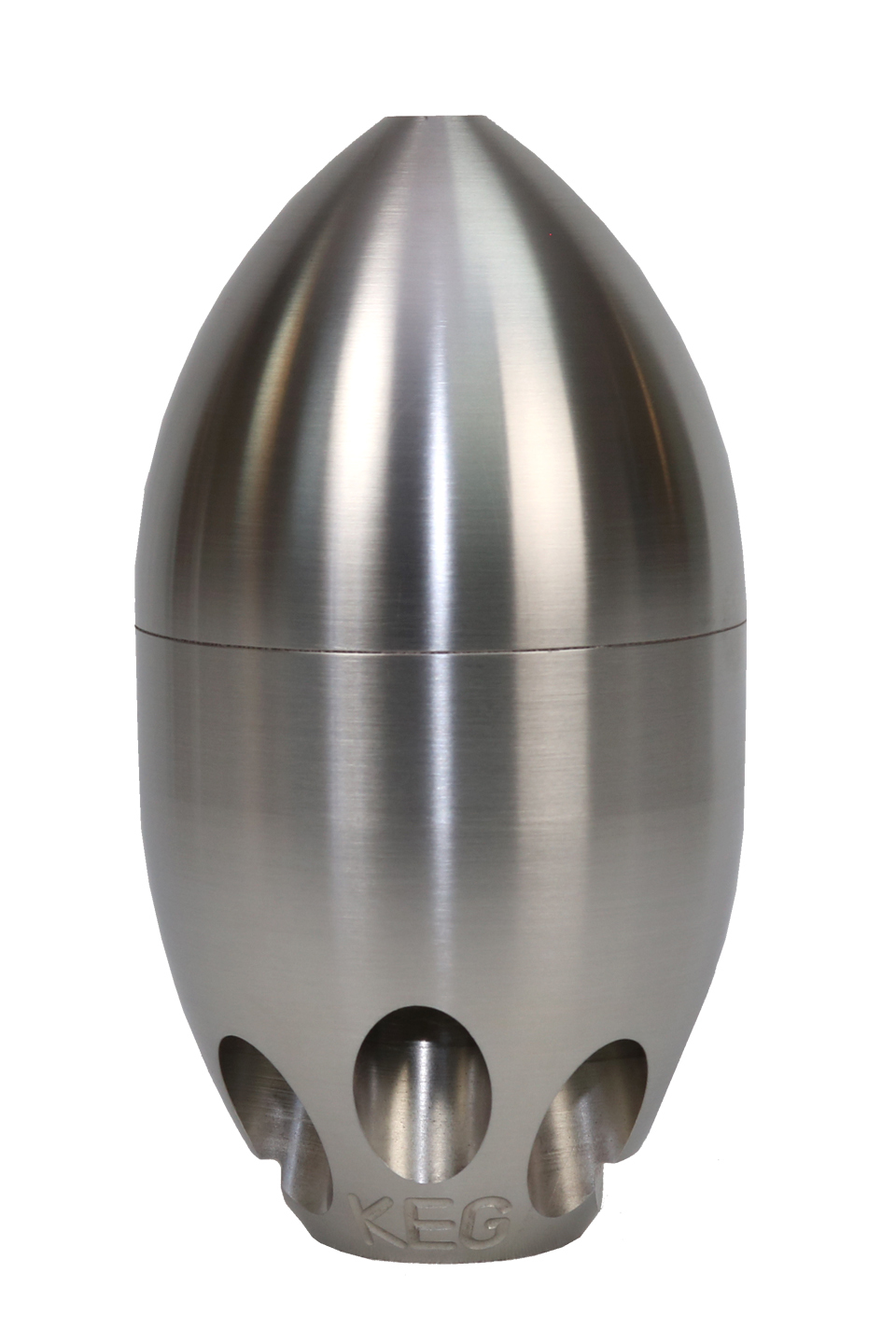
“KEG has the engineering figured out,” Benner says. “It’s the way the nozzles are built and the amount of water they use. Say you’re cleaning a 12-inch pipe that’s been in the ground since the mid 1950s, which is pretty common in a lot of the industrial places in the Pacific Northwest. We even get into wood-stave pipes. Any time you stick a nozzle into those lines you’re asking to create damage, to wear pipe walls. So what you want to be able to do is make a pass through that line and maybe do one more cleanup run. What we’ve found with these KEG nozzles is they move so much material, we’re not running in and out of lines 10 times to clean.
“You want to get in and out of these lines rapidly. It saves the customer money. You’re not sitting there chewing on a line for five hours. You can get out of a line in an hour. It’s imperative to our customers because they’re already running a tight budget. These paper mills, refineries, metal manufacturers. They’re all telling you that money is crucial and they need a vendor that can come in and get the job done with efficiency and no damage to the belowground infrastructure.”
Good vibrations
Another valuable member of Ventilation Power Cleaning’s nozzle roster is the DUCE nozzle. It’s not meant to be an all-purpose nozzle, as the DUCE name is an acronym for “Don’t use in clay ever.” KEG warns against using a vibratory nozzle in clay pipe or in any pipe displaying cracks, fissures or damage. But Benner says it’s definitely helpful for certain types of jobs.
“It’s a very destructive nozzle, so you have to be careful, but it works really well.”
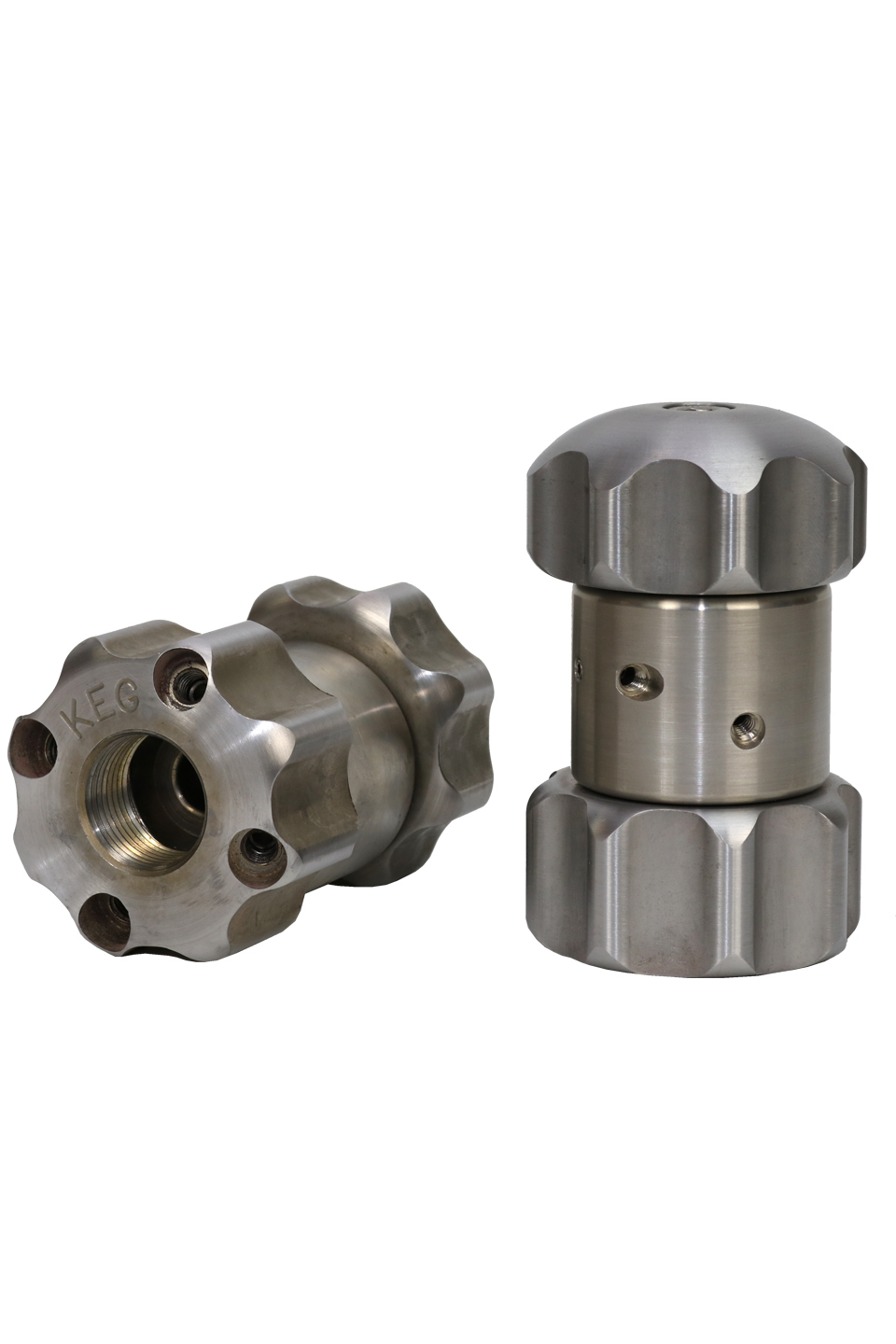
The DUCE nozzle utilizes water-driven rotation and vibration to create a unique “jackhammer” action that removes difficult materials such as scaling, grout/mortar residue, tuberculation or other deposits within pipes. Ventilation Power Cleaning typically uses it for calcium buildup in paper mills and in concrete plants.
“They are constantly getting concrete dust in their lines,” Benner says. “That’s just the way it is, particularly in the Pacific Northwest where we have so much moisture buildup. Their lines are constantly getting clogged.
“It’s not a nozzle you would give to anybody and just say go to town. You have to know how to use it. It is a very aggressive nozzle. It’s a dangerous nozzle to use, but that’s OK. That’s what we want. We want something that’s going to get in there and create some turbulence, create some violence in that pipe.”
Still, compared to an alternative method for handling such hardened deposits, like chain cutters, the DUCE nozzle is less prone to damaging pipe, Benner says.
“Most applications where we use the DUCE, it will work a lot better than a cutter,” he says.
Survival of the fittest
Beyond the actual nozzles, Benner says he appreciates the level of service KEG Technologies provides, like training.
“You can give someone the right equipment, but without the right training it’s all for naught,” he says. “KEG does a nice job with training. They’ll come to your facility and teach guys how to use equipment. Flushing lines is an art. It refines with time and a lot of knowledge is passed down generation to generation.”
KEG Technologies nozzles help keep Ventilation Power Cleaning productive on the job and that in turn keeps customers calling on the company for cleaning services.
“If you go out there and don’t perform on a project, they’re most likely not going to call you back. They’ll go to somebody else in a heartbeat,” Benner says. “If that person fails them, eventually it might come back to you, but you don’t really want to give the customer that option to begin with.
“It’s imperative to use good equipment, nozzles in particular, because if not we’re going to be out of business. In 40 years of doing this, I’ve seen just about every scenario. KEG has gotten us out of a couple of jams.”
Continue reading for free