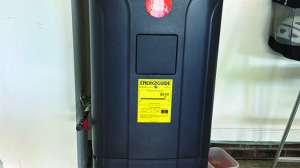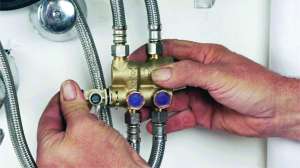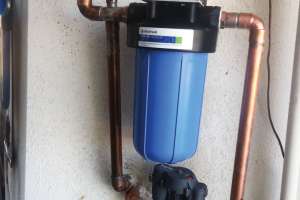
The components for the backflow prevention valve sit out in the company shop, ready for assembly.

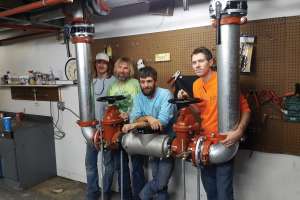
The staff that worked on the backflow prevention valve were Taylor Votion, Josh Mason, David Wright and Mike Wells.


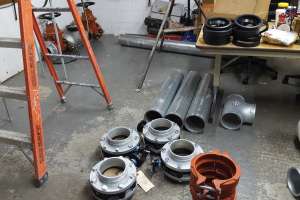
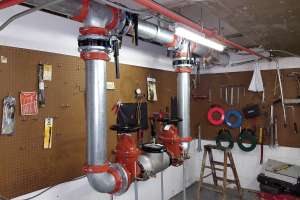
The components for the backflow prevention valve sit out in the company shop, ready for assembly.
The staff that worked on the backflow prevention valve were Taylor Votion, Josh Mason, David Wright and Mike Wells.
A short time frame and a tight workspace didn’t stop Dan Seligman and his team at Biggs Plumbing from completing an installation of a backflow prevention valve at a multistory hotel and office building.
The five-man crew from the Austin, Texas-based company would only have seven hours to install the valve and a double-check device at the water entry of the building.
After planning the job for several months, making sure the design of the new system and shutdown of the current system would both work, the company took on the job in December. The crew managed to complete the job in only five hours.
SECURING THE JOB
In the last few years, Austin authorities began enforcing an ordinance that requires backflow prevention at the water entry of existing buildings taller than 80 feet. Double-check devices are also required.
“We have been putting them in new buildings for the past several years,” says Seligman, a project manager on the commercial construction side for Biggs Plumbing. “This was the second of these retrofits that we have done.”
Biggs Plumbing is a family-owned operation that has been in business since 1972. The company, led by William Biggs, has about 70 employees. With a present focus on high-rise buildings, including multifamily condos and apartments, hotels, and office buildings, the company knew this job would be a good fit.
The company quoted the job in July 2017 and won. The work would take place in December. The biggest issue right away was the time frame.
“We were scheduled for this shutdown on a Sunday night since the hotel would have low occupancy,” Seligman says. “We couldn’t turn the water off until 10 p.m. and needed to have everything back up and running by 5 a.m. Monday.”
PREPPING FOR THE JOB
Work on the job began weeks ahead of the actual planned shut-off. Seligman and co-worker Mike Wells planned the work, measuring the existing piping in advance so the cuts for a 6-inch galvanized pipe could be grooved ahead of time for the new valve.
“We had the piping fabricated through one of our local vendors,” Seligman says. “We have the equipment to do that work, but we were short on manpower. Also, since they were fairly short pieces, we would have wasted a lot of pipe by buying full joints.”
A week before the job, crews made a hot tap on the bottom of the current 6-inch galvanized pipe to add a 3/4-inch valve with hose connection to facilitate draining into a shower in the adjacent building.
“During the installation of that valve, we found the shower drain was clogged, so we needed our service crew to unclog it before Sunday night,” Seligman says.
Crews also built the support for the backflow device and put a few pieces together.
“Due to the small space in the engineer’s storage room, we wouldn’t have room for lifting equipment,” Seligman says. “We put together the flanges on the butterfly valves and a few other parts, but most was done with individual pieces to keep the weight down.”
On the Monday before the job, the company’s backflow tester certified the device and filed the report with the city authorities.
GETTING TO WORK
On the night of the job, crews arrived — with three of them driving from their homes an hour away — and assembled the backflow system.
The only challenge the crew faced was the isolation valve inside the building not holding.
“We had to turn the water off at the meter in the sidewalk vault,” Seligman says. “We lost some time deciding whether it was just slow to drain or the valve wasn’t shutting off completely.”
Crews also installed a bypass with the backflow system, which is something that usually isn’t acceptable on backflow devices but was requested by the customer. Seligman says the bypass was removable since they expected the inspector to require it to be taken out.
“I really have to hand it to the crew,” Seligman says. “Of the four guys, two of them were pretty new to the trade, one has less than a year’s experience, and Mike did a great job giving them detailed directions so that no mistakes were made. I was right there only to give guidance from my 40 years’ experience.”
VERY LITTLE MAINTENANCE
Looking ahead, Seligman says there should be minimal maintenance needed on the double-check device, saying they only need to be tested at the time of installation under the local ordinances.
However, if a problem does arise, Biggs Plumbing will be there.
“We work in both sides of this building on a regular basis,” Seligman says. “The hotel and office have different management companies and we are the preferred vendor for both.”
Seligman is already looking forward to working on the company’s next double-check device: “I really enjoy this kind of work. We don’t get to do these shutdowns or major replacements often, so I look forward to the problem-solving aspect.”
Continue reading for free