Those two traits inform many aspects of his business, from the service area he’s staked out to the processes and protocols his technicians follow to his growth strategy.
“I’m extremely analytical and stress efficiency,” says Marvon, age 43. “I feel this is very important when you’re in business because the more you get done, the more money you make — and the more you can do and the more money you can make tomorrow.”
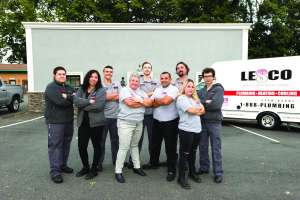
So far, the two-pronged emphasis has worked well. Marvon says the company now employs eight people, runs five service vehicles and makes thousands of service calls a year. About 95% of the company’s plumbing work is residential service and repair.
Providing top-notch customer service also has played a key role in the company’s growth.
“It’s really important to treat customers like kings and queens — treat each and every one like they’re the only customer we have,” Marvon says. “Our technicians are taught to always be considerate and put the customer first.
“The customer always is right.”
AN EARLY START
Initially, Marvon was interested in becoming a mechanic and actually attended vocational school to learn how to repair cars. But then at age 17, he agreed to work for a family friend, Rick Edwards, the owner of R. E. Plumbing in nearby Livingston.
“He was a great mentor and teacher,” Marvon says. “He allowed me to go with him on job estimates, listen to calls with customers and so forth. I saw how he handled everything and he always took time to explain things to me.
“Rick gave me insights into the industry, both the plumbing work and the business side, and I just fell in love with it,” he continues. “I found it fun and interesting and loved the challenges. So I forgot about the automotive industry and stuck with plumbing.
“It definitely was the right path,” Marvon adds. “It was something that came naturally to me.”
Marvon established Lesco Plumbing in 2004, when he was just 25 years old. Why did he name it Lesco? Primarily for branding purposes — and, of course, simplicity.
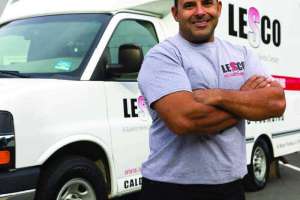
“I didn’t want to use my last name, but I wanted a word that’s simple and easy to remember and that would work good with my logo,” he explains, noting the over-sized and prominent “S” in the word “Lesco” on the company’s service vehicles.
“I’m a big Superman fan and the big ‘S’ is like the ‘S’ on his chest,” Marvon says. “It’s a totally made-up name, more for branding than anything else.”
STEADY GROWTH
The company enjoyed steady growth, with 10 to 15% annual revenue increases.
“It seemed like every year and a half, I had to hire another technician and put another truck on the road, just to keep up with demand from customers,” he notes. “I couldn’t afford to tell customers they had to wait a week for service.”
It certainly wasn’t easy, however. Marvon initially decided to compete in an area with several third- and fourth-generation, family-owned plumbing companies.
“They were the Goliaths and I was the David,” he says.
Why go head-to-head with well-established companies? For starters, the area had more affluent customers, he notes.
“I also like a good challenge,” he says.
How did he compete? By offering lower prices, which was doable because he ran a low-overhead business at the time, and providing great customer service.
“I was small and efficient,” he recalls. “I really upped my game to meet the challenge.
“I also made sure we didn’t overgrow — that we operated very efficiently,” Marvon adds. “It never was my goal to have 50 or 60 trucks. I wanted to run a manageable-sized business that would provide me with some flexibility and freedom.”
More customers required more equipment. Today the company runs six service vehicles, a mix of GMC Savana and Chevrolet cut-away vans equipped with 12-foot box bodies from Unicell Body Co.
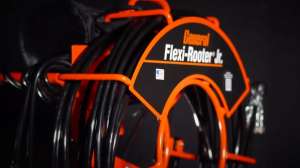
Technicians use Super-Vee handheld drain machines made by General Pipe Cleaners, Milwaukee Tool Switch Pack sectional drain machines and M18 Fuel Drain Snakes; an Electric Eel Model C sectional drain machine; Milwaukee Tool hand drills; a Milwaukee Tool M-Spector inspection cameras; and RIDGID and Milwaukee Tool ProPress tools.
SMALLER IS BETTER
The simplicity/efficiency equation also informed the size of Lesco’s service area.
“As I built the business, going on service calls that were farther away just didn’t make sense to me,” Marvon explains. “For me, it always was about being smaller and more efficient.
“We like to stay in our area, where the next call is maybe two minutes away,” he continues. “That way we can total more billable hours per day — make up for in efficiency what we lack in the service area. In the end, it’s not what you charge, it’s what you keep — and setting our guys up for efficiency helps us keep more of what we earn.”
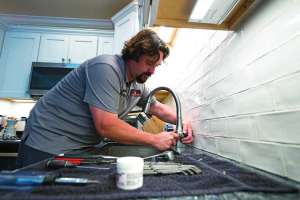
Technicians are trained to be as efficient as possible. For example, they’re not allowed to walk up to a house empty-handed. Instead, they’re trained to take a carry bin with them that holds all their major tools and repair parts, even if they’re only using two fittings for a repair, he says.
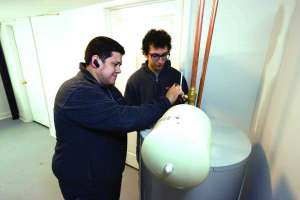
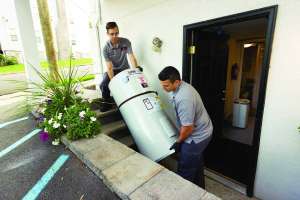
“Every unnecessary step taken to go back to the truck is wasted time,” Marvon notes. “When our technicians replace a boiler, for example, we order all the parts we’re going to need ahead of time and have them delivered in one box to the job site.
“That way there’s no need to keep going back to the truck to get different things from different bins,” he adds. “Every minute they’re out looking around for something in a truck and not in a basement working is lost time.”
The systematic approach yields productive results; Marvon says his five plumbing technicians made 2,735 service calls between mid-October 2021 and mid-October 2022.
EFFICIENT JOB ROUTING
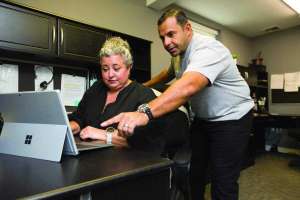
Marvon says he also works closely with the company’s dispatchers to make sure they understand routes.
“That’s huge,” he says. “A good dispatcher can make or break efficiency. You need to schedule people in such a way that minimizes windshield time, so you have to be familiar with neighborhoods and geography.”
The dispatcher tries to schedule jobs that are farther away in the middle of the day, to avoid morning and late-afternoon rush-hour traffic. Sending a technician to a farther-away job site during heavy traffic might mean driving 45 minutes to an hour.
“It’s all about understanding those efficiencies within your community,” Marvon emphasizes. “During the course of a year, efficient dispatching is not a small thing.”
Furthermore, if a technician finishes a job early, dispatchers are trained to look at the schedule for the following day to see if there are any customers located along that technician’s route back to the shop.
“That way they might be able to squeeze in one more job on that day,” Marvon explains. “And then if a customer calls the following day, we’ve got an open spot. “It’s always easier to call a customer ahead of schedule and get there early and be a superhero than to over-schedule guys and then have to reschedule customers. That puts a hardship on customers, which we want to avoid at all cost.”
The approach works; Marvon says that 90% of the calls for service come from repeat customers or word-of-mouth referrals.
To motivate technicians to always provide great customer service, the company gives them a free spin on a “lottery wheel” whenever they get a positive online review. They might win from $10 to $200 in cash, Marvon says.
“We incentivize them to do a good job, not upsell jobs,” he explains. “I’m not big on commissions.”
NEW BUSINESS LAUNCH
As for what lies ahead for Lesco, say, five years down the road, Marvon sees more of the same: slow, manageable growth that keeps customer service front and center.
“The point we’re at right now is a nice sweet spot,”
he says.
Retirement also beckons. Marvon says he already works part-time in order to focus on various hobbies and his family. Because his only child, a son named Carter, is just five years old, Marvon has no succession plan to keep the business in the family.
So the entrepreneur instead envisions several key employees buying an equity position in the company and running it after he retires.
“I’d like to keep the company in the hands of the key team members that got it where it is now,” he notes.
Marvon says he would stay on board in a consultant role.
In the meantime, he also plans to devote more time to a franchise drain-cleaning business he calls Smiley Drain Cleaning, established in 2020.
“It’s going well and I plan to push that business for about seven more years until I retire,” he says. “That’s my goal, anyway.”
But one thing is for sure: Smiley Drain Cleaning will be run on the same core values of simplicity and efficiency that made Lesco a success, he says.