
HVAC equipment is getting smarter. Homeowners and businesses investing in the new heat pumps, furnaces and water heaters want contractors to stay on top of the best consultation and systems installation practices.
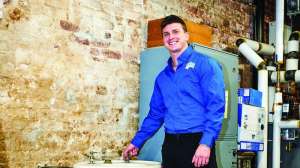
That helps lessen the systems’ integration and optimization complexity for customers like Isaac Tessmer, owner of Blue Ribbon Builders.
Achieving optimal heating and cooling efficiency is a challenge in regions with warm summers and extremely cold winters. Tessmer is thermal-minded and into modern concepts.
He recently obtained Energy Star certification for the uber-efficient custom home he and his wife built on 15 acres near Winterset, Iowa.
The couple was eager to enable consistent year-round HVAC system performance, reliability and longevity, and the right controls for meeting domestic needs and individual preferences for convenience and comfort.
The builder’s first call was to plumber and HVAC specialist Rod Brace, owner of Des Moines, Iowa-based Advanced Problem Solutions.
AN EFFICIENT ZONE
The Tessmer residence includes over 3,000 square feet on the main level, 14-foot clear story in the primary living space, 9-foot clear story in other areas, two bedrooms, two office spaces, three baths and a full, unfinished basement.
Structural insulated wall panels used in construction provided high levels of insulation and air tightness. Thermal breaks and perimeter closed cell insulation for minimal conductivity reflect the builder’s emphasis on whole-house energy efficiency.
Brace’s favorite pastime is outsmarting problems. An authorized Rheem distributor for decades, he’s touched a lot of furnaces and water heaters over the past 40 years.
“You could have the most efficient system,” Brace says. “It’s not only the equipment that’s important, but the installation and the contractor for the homeowner being a good fit and doing a correct install.”
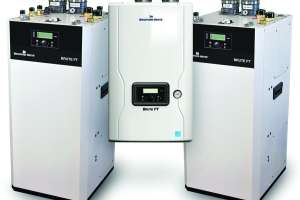
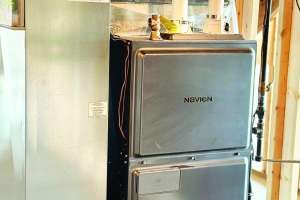
From that perspective he hatched an equipment formula and installation prescription and Tessmer approved. The order included a TOSOT air-to-air heat pump, a Navien NPE 240 series instant-on water heater and state of art NPF700 series condensing vertical upflow hydro-furnace from Navien.
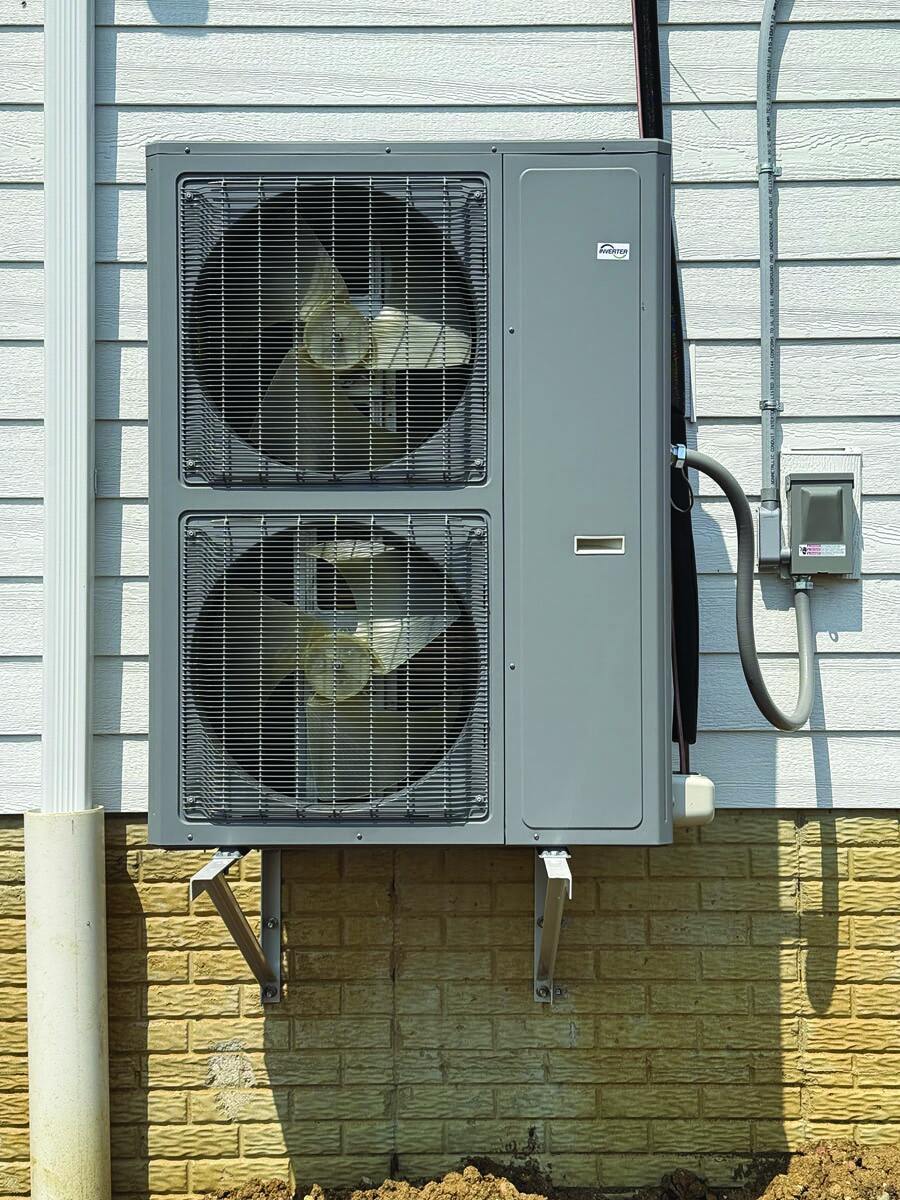
TOSOT electric split and side-discharge systems often feature a compact and flexible design, making them suitable for various installation settings such as new constructions and retrofits in Northern climates.
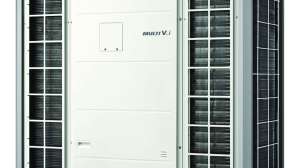
APS installed an all-electric APEX series ducted central heat pump system (TOSOT), rated at 48,000 Btu with a 4-ton inverter-driven compressor. The outdoor unit with low ambient performance is designed to perform in temperatures as low as minus 22 degrees F and as high as 118 degrees F, according to the manufacturer.
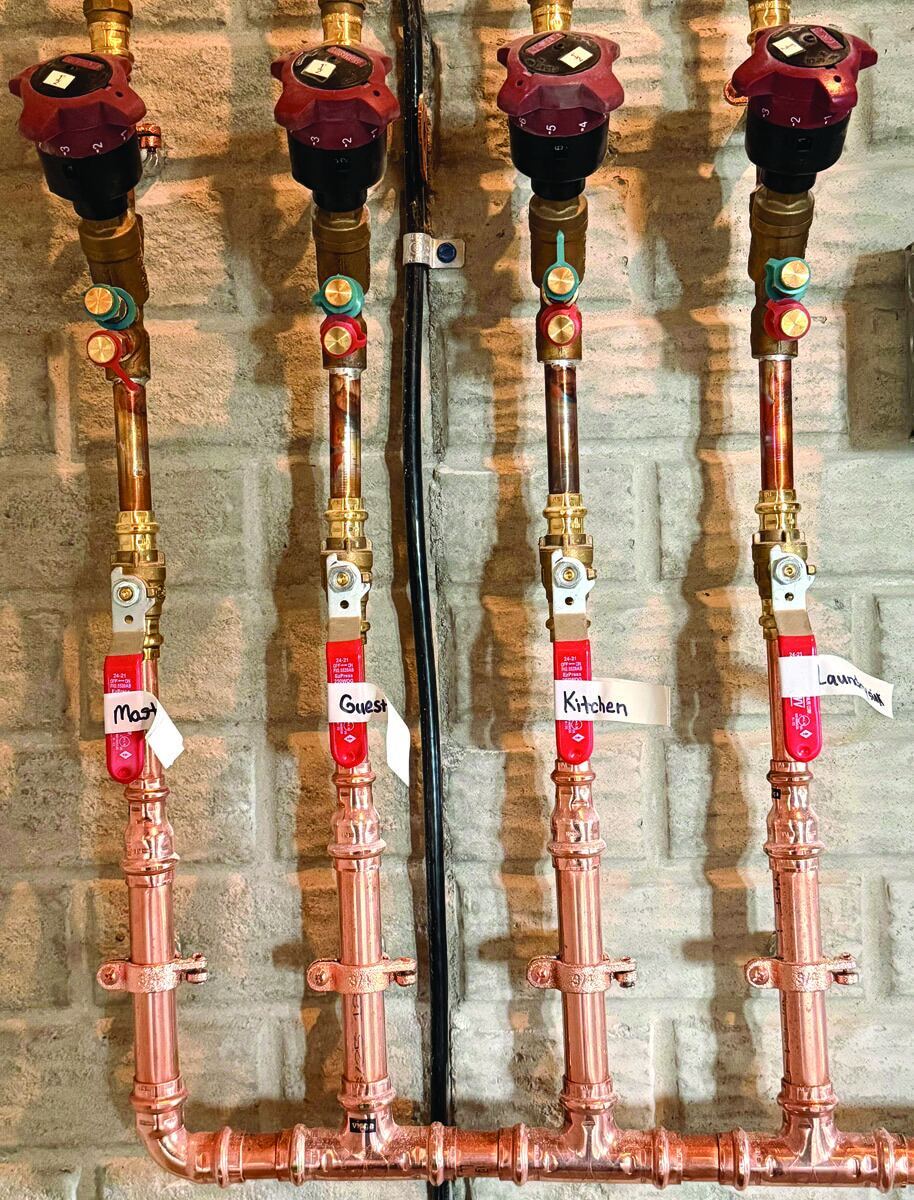
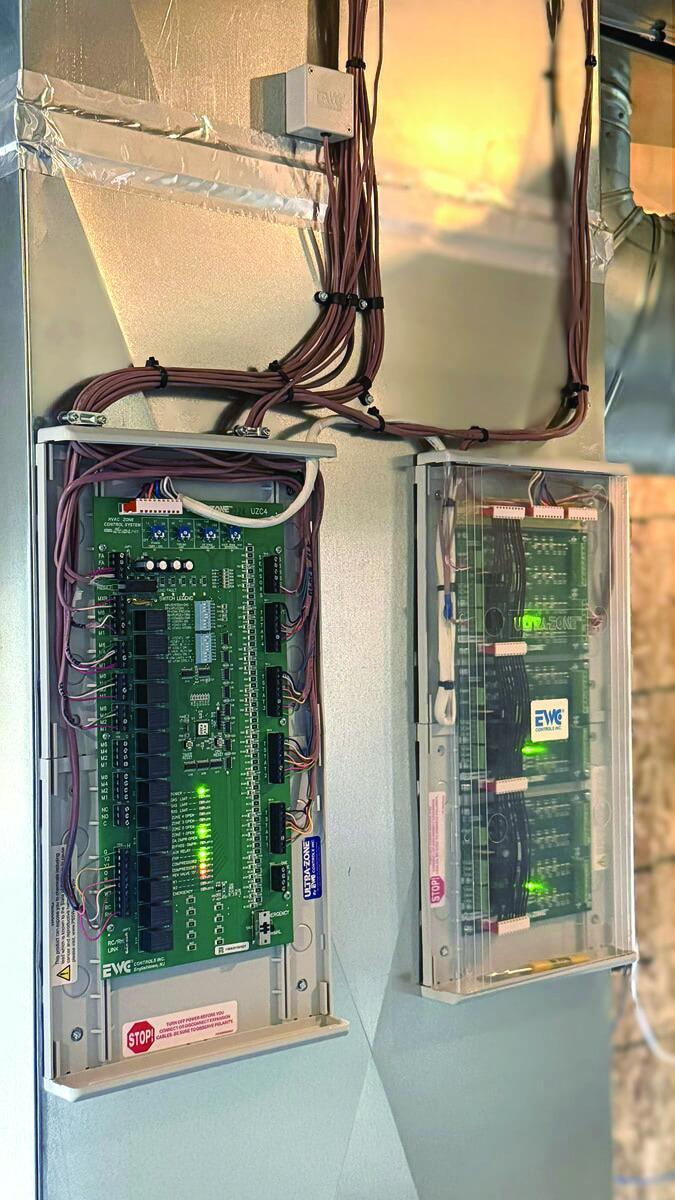
Their scope of work included installing and wiring an advanced EWC Controls Ultra-Zone system and control panel for a zoning board and the auto-adjusting bypass dampener. Mainline HVAC web-based programmable thermostats were added to facilitate bypass and zoning for five areas in the home.
“We ramped up to max blower speed and then set it to the lowest,” the contractor says. “It opens up and will constantly adjust the bypass. This automatically sets it up for you, expandable up to eight zones.”
BRACING FOR THE FUTURE
Brace has worn many hats, from installing ceramic coating heads and pistons for NASCAR to servicing restaurant and refrigeration equipment — his interest is in all things mechanical.
“I used to do diesel mechanic work, went to college, built vintage race cars for a collector and eventually started APS,” he says.
The traditional focus for Brace’s company is HVAC and refrigeration work, as well as drain locating and installations, for commercial and industrial jobs. They’ve grown into an 18-service truck organization and continue to expand.
In 2023, the contractor closed on the friendly acquisition of another local commercial HVAC company, relocated and expanded into a larger building, and added a residential plumbing and HVAC services division.
The 30-plus employee organization serving Greater Des Moines and surrounding areas is leveraging tradecraft knowledge and taking on the challenging work where it leads them.
A NEW FURNACE
Navien began shipping the NPF upflow gas hydro-furnace in 2023, with horizontal models following. In 2024 the product was a finalist for the IDEA Design Awards, recognizing comfort and sustainability.
Brace sees the hydro-furnace’s condensing technology as a significant step forward for residential heating, and in his view, its heat exchanger represents one of the most impactful innovations in recent decades. He likes it so much that APS recently installed a 100,000 Btu NPF unit in their own headquarters.
Here’s how they work.
In a conventional furnace, where gas is burned directly in the conditioned airstream, the heat exchanger can be exposed to temperatures up to 1,000 degrees F. These high temperatures can dry out the air and cause premature wear and tear on system components.
The hydro-furnace burns gas at a much lower temperature in a sealed compartment. Heated water is pumped through a stainless steel hydronic heat exchanger, which remains isolated from the conditioned airstream. Navien states the hydronic coil transfers heat to the airstream at temperatures up to 150 degrees F.
Units are configured with standard left-side gas, electrical and water connections — field-convertible to right-side setups. Fine-tuned performance is enabled by a high-efficiency modulating burner and a variable-speed ECM blower motor, delivering 97% AFUE and ultra-low NOx emissions.
SPLITTING THE BILL
An NPF700 unit with 80,000 Btu capacity became a centerpiece of the Tessmer home project for APS. It is designed for variable capacity operation ranging from 15% to 100%, supporting both natural gas and propane applications.
The contractor set it up to run on Tessmer’s propane as a backup in the event of electrical power loss, or when the need for supplemental heating arises — boosting reliability and energy efficiency in colder climates.
In Brace’s experience, by exploring the available therm calculator from local utilities, it can be determined at which temperature it would be more efficient to run propane and hydro-furnace than to run the air-to-air heat pump.
The system can be programmed to shut the outside heat pump off automatically and switch to the hydro-furnace, he says. It all depends on outside temperatures, the home’s insulation profile, local propane and electricity rates, and future kWh costs based on the local utility provider.
He explains that the TOSOT heat pump retains up to 85% of its capacity at minus 22 degrees F, and estimates that around minus 10 degrees F to minus 12 degreesF it may become more cost-effective switching to the hydro-furnace.
“What’s the actual cost efficiency of the energy?” he says. “My guess is it is somewhere around 10 below zero to 12 below, it would be cheaper to run the Navien per therm. That’s the homeowner’s choice. This is a really good fit for people who are on propane.”
STRONG INSTALL
NPF hydro-furnaces are compatible with most single or dual stage thermostats, and integrable with indoor humidity and air quality technologies. All models are approved for one or two pipe vent installations.
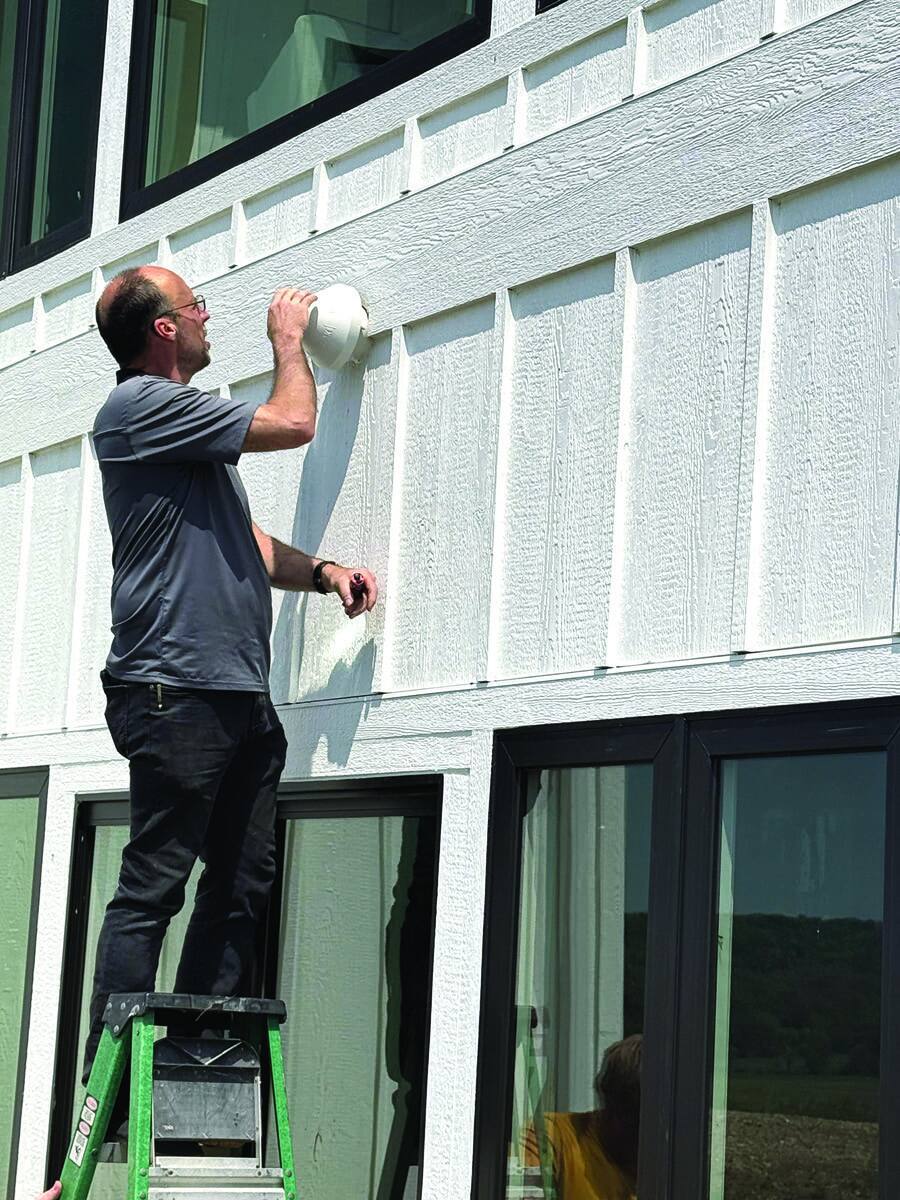
The max vent total calculated pipe length is 70 feet for a 2-inch vent and 140 feet for a 3-inch vent, according to the manufacturer. APS’ run included approximately 55 feet of forced draft direct 2-inch PVC venting, including elbows, using a 1/2-inch gas connection size and 3/4-inch for the condensate.
A clearly marked Molex terminal strip and board located at the front of the blower compartment makes the control wire connection easier and more reliable, Brace confirms, while a vent installation detector adds safety during installation.
MADE OF STEEL
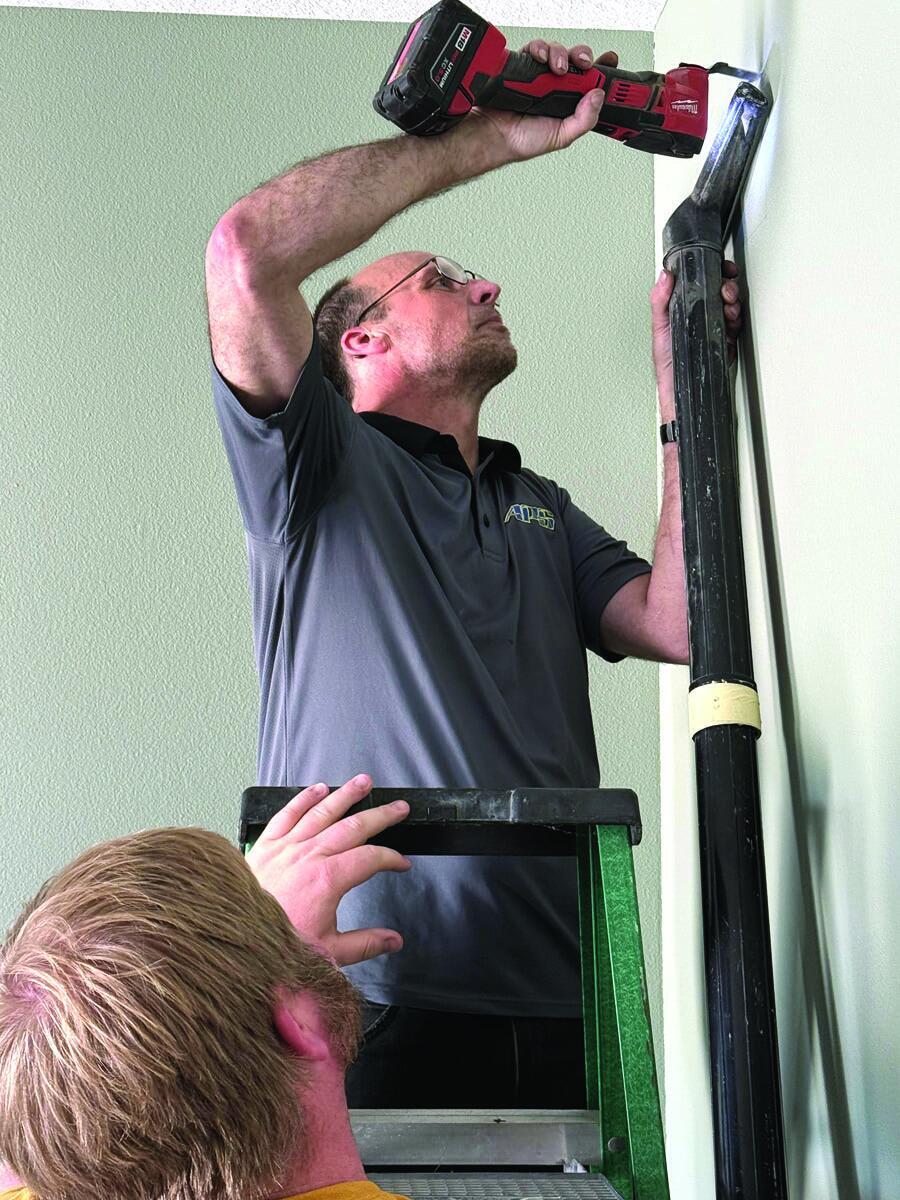
The steel in the side of the Navien hydro-furnace has nearly double the wall thickness of a conventional unit, Brace notes, revealing the quality of the components and making installation only slightly tougher.
APS head installer John Gioffredi powered through the cut out using a Kline hand shear. Brace says most installers will prefer a power shear, like the early Bosch tin shear.
“My guy did it. Most people don’t have that type of grip strength. It’s a testament to that. If you are not a beast, you will want to use a power shear, I like the early battery-operated Bosch tin shear.”
A plasma generator was additionally installed on the hydro-furnace to kill mold, mildew and viruses.
Their crew vented all bathrooms, the kitchen and summer kitchen, and tested all equipment. All ductwork for the project was laser-aligned for perfect straightness and sealed with mastic. For APS’ part, all their equipment and supplies for the Tessmer project were sourced from Ames, Iowa-based McDonald Supply.
“A normal install for just a furnace is one day for two guys,” says Brace. “For this job, we were on site for about a week.”
PUMPED UP
The NPF700 comes with propane and high-altitude kits, airflow options for side or bottom returns, and a cabinet that allows the blower to remain sealed during maintenance.
Water fill can be handled manually every year or approximately 18 months, or through a connected autofill line. A backlit display and self-diagnostic software are intended to make setup and system checks simple for both installers and end users.
Brace expects the units will be a “30- to 40-year” furnace. Soft-start and stop capabilities minimize power surges, support low-speed operation and reduce strain on the blower, helping to extend service life and boost overall HVAC system reliability.
However, he emphasizes potential for reduced labor costs if an exchanger ever does fail or needs replacement. “During manufacturing on a normal furnace, the heat exchanger is one of the first things to go in and last thing to come out,” he says. “With this furnace, the heat exchanger is the last thing to go in.”
“A lot of furnaces have a ‘lifetime’ guarantee,” the technician adds. “In 10 or 15 years, if that heat exchanger does crack, every last piece has to be disassembled. They’ll give you a new heat exchanger, but the labor is going to total it. With [the hydro-furnace], it’s literally one hour of labor.”
“The air source heat pump is something I did want, APS reinforced that, Rod had the right prescription for that,” the homeowner chimes in. “The hydronic heating system was something I had never heard about before at all, and Rod introduced me to that. It sounded like a neat aspect of a new furnace.”
COVERING ALL BASES
For Tessmer, a rural homeowner and independent builder innovating to go green, the push is toward the best and highest use of anything that brings long-term value. His company, Blue Ribbon Builders, based in Earlham, Iowa, emphasizes craftsmanship and service through a team-based environment and collaboration with contractor partners.
Established in 2004, Blue Ribbon Builders delivers a range of projects across Iowa, from complete commercial construction and multifamily housing to custom homes. The company also gravitates toward agricultural and industrial work, including water and sewage treatment plants and related municipal facilities.
Efficiency trends are shaping the plumbing and HVAC market, yet Brace notes contractors can’t overlook the basics. Poorly sized return ducts, for example, are a frequent source of problems, from comfort complaints to potential for damage and costly remediation.
One way APS safeguards against issues like poor humidity control and increased wear or maintenance needs is through performing a Manual J heat-load calculation on every project. By ensuring each system is properly sized for the home’s design, insulation and climate, they help facilitate reduced energy waste and improved long-term performance.
“The NPF takes a lot less energy on his backup generator, contributing to fuel savings,” Brace explains. “He did not have to size his generator so large to run his whole house, either. We sized it and were able to put in our TOSOT heat pump that is variable load, that will ramp up, so this one I can oversize that on the heating side a little bit. Being very precise on that.”
BRINGING IT HOME
“Energy is not getting any cheaper,” Brace begins summing up. “This is going to steadily increase in our industry, the zoning and the new technology. I think those are going to be the big forefront of the HVAC world.”
He sees HVAC manufacturers and the industry moving toward sustainable products that last or improve efficiency and comfort across diverse and challenging climates.
Builds like Tessmer’s highlight how expert HVAC installation and careful system design can deliver reliable comfort, energy savings and long-term performance. “I have got a custom system here, for what my wife and I wanted, for this space and how we live in it,” he states. “My wife and I wanted the zoning for sure; we definitely have different comfort levels. It’s something we agreed upon ahead of time.”
“He has a super efficient house,” Brace concludes. “They have a high-end heat pump, NPF as backup heat and five zones within 1 degree F tolerance, hooked to the internet and their smartphones.
“In milder winters, the Navien furnace probably won’t even run.”
Continue reading for free