
My smartphone has 51,000 pictures on it. I pay an extra $2.99 per month for extra storage on my phone and it’s worth every cent.
Here are some of the things our company makes sure all our field technicians take pictures of:
- Driveways before we drive on them. Obviously when there’s another way onto the lot we don’t use the driveway. When you have to use a driveway for equipment and truck access, make certain to have written permission. Our written permission slip has a disclaimer that our company is not responsible for damage to nor repair of the driveway. Take pictures before you drive on them. Many times we’ve gotten a call that we cracked the driveway, and when we meet the customer and look at the crack, it’s a crack that we have a picture of prior to ever driving on it. Also take pictures of the driveway after the job is done so you have a good record of how you left it.
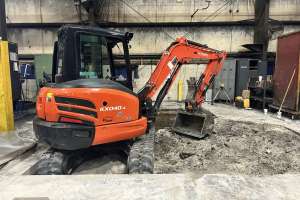
- Renting heavy equipment. Every time we have a job where we need a larger (or extra) piece of heavy equipment, we immediately take pictures of the piece(s) of rental equipment all the way around and underneath. When we are done with the piece of equipment we take pictures all the way around the machine and underneath. It seems a lot of times after returning the rental equipment we get a call that it was returned with damage. I remember the first time we got this call. They claimed something was cracked under the machine. When we said we have before and after pictures, they said, “Oh yeah, that crack shows up on our before pictures.” Recently I had an operator tell me, thanks for teaching us about the before and after rental pictures; again, we got a call recently after the machine was returned that supposedly there was damage. The operator had taken before and after pictures, proving that while we had the equipment the supposed damage was not observed on the machine. The rental company agreed to pursue the matter with the delivery company.
- Utility locates. This is the big one. You get to a job site, and the first thing you do is check the area you are going to excavate to see if there are any utility locate marks (paint or flags). If there aren’t any markings at all, take several pictures of the area you are going to excavate. These pictures prove there was nothing marked in the area you are going to excavate. If there are markings, whether paint or flags, it is very important that you take pictures of those to prove exactly where they are. If they did not use flags and used paint only, you might want to consider using cones, or Hit Kit markers, or anything that shows up well as sometimes paint lines are quite hard to see in photos.
Prior to excavating make absolutely sure that the utility locating company had been to the site and marked the utilities. In the state I work in, we are not allowed to start excavating if the utilities have not been marked, even if we have passed the start date and time given to us by the utility locator. In most cases but not all, our utility locating company will email us a letter at the start date and time to let us know if it was marked yet or not.

Walk around the building on the site and look for overhead utilities, gas and electric meters; just because those may be on the other side of the building does not mean it’s safe to start excavating if the utilities have not been located.
Once you are excavating, if you do dig up a utility that was not marked or was not marked properly, take the following steps:
- If you exposed or damaged a gas line, shut off equipment, move everybody safely away from the area, notify the gas company’s emergency phone number, contact the utility locate company, notify those in the building that a gas line has been hit, and in most cases it is recommended they evacuate the building. The reason the building should be evacuated is when a gas line is hit, there’s always the possibility that the line pulled out fully or partially at the meter, which could cause gas to begin filling the building. In the area I work in, a utility crew working on a street hit a gas line; it affected a connection at a gas meter blocks away at a church, the church blew up and a person was killed. All because a gas pipe was hit, blocks away. Do not resume working until the gas company has made a repair and gives the all clear.
- Electric. I had a crew working on a project and the excavator dug into the ground and pulled up three large electric mains. They were not marked. We had been given the all-clear by the locating company. We called the locating company, and the electric company. There were absolutely no marks anywhere where these mains were dug up. This was dangerous on many levels. The excavation of these mains caused an entire subdivision of homes to lose power. The first person on the scene was the person who should have marked the lines and his comment was, “I drove by and did not think you’d be digging here.” As he said that, he began marking each side of the excavation with paint lines, as though trying to make it look like it had been marked prior to the excavation. Our entire crew had taken pictures of the lack of markings and of the locator making after-the-fact markings. On our hit report, they all corroborated that he said he did not think we’d be digging there (although it was clearly within the area we asked to be located). This was a large ‘hit’ and many other supervisors and repair crews showed up after the locator did. Because we were all standing there and had pictures of him adding the lines he admitted he never marked it.
- If you dig up a line that was marked, but marked incorrectly, it is important (only if you can do so safely) to document where the utility locate lines were, in relation to where you actually encountered the utility. A “Hit Kit” works great for this because the items that come in the kit (very large tape measure, marking posts and damage posts) make it very easy to set up and photograph how far off the utility locate paint lines actually were. Hit Kits are worth their weight in gold because these are the best way to document how far off the locate actually was.
I do realize that more contractors are doing their own utility locates, but in my state it’s still the law that we have to contact the one-call utility locate service.
Documentation is crucial to protecting your company’s bottom line. You cannot take too many pictures of sites, rental equipment, roads and driveways. Working closely with your local utility locator and always working carefully are crucial to your co-workers’ and customers’ safety.
About the author: Todd Stair is vice president of Herr Construction, Inc., with 34 years’ experience designing, installing, repairing, replacing and evaluating septic and mound systems in southeast Wisconsin. He is the author of The Book on Septics and Mounds and a former president of the Wisconsin Onsite Water Recycling Association.
Continue reading for free