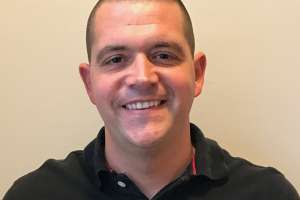
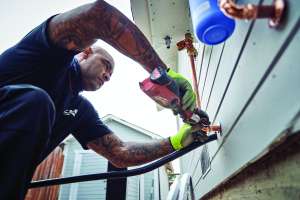
Pecoraro’s recipe for success? Do quality work, backed by a warranty, and go the extra yard for customers. Prioritize honesty and transparency. Invest in labor-saving and productivity-enhancing equipment. And mentor young technicians while creating a company culture that emphasizes all of the above.
“The biggest keys to our success have been honesty, transparency and a willingness to help customers, especially with heating calls in winter,” he says. “Even if you get a call at midnight, you’ve got to go out and do the job.”
A simple little thing like returning phone calls also pays big dividends in terms of customer retention.
“Even if I can’t do a job, we call people back and refer them to good plumbers that will take care of them,” Pecoraro explains. “In 2020, I even hired an employee that only answers calls and schedules service calls after we got a bad online review because I missed a service appointment.”
That hire reflects another key to the company’s success: delegation of responsibilities that freed up Pecoraro to pay attention to higher-value issues — work on the business, rather than in the business.
“That was critical for us to grow,” he notes. “I was handling just about everything — phone calls, scheduling jobs, doing estimates, doing jobs.
“We were growing too much and too fast,” Pecoraro continued. “We had as many as six technicians, but were making less money. I figured if I had six guys I’d make six times as much money, but it didn’t work out that way.
“It was a good learning experience.”
UPHOLDING A FAMILY LEGACY
A solid work ethic and entrepreneurship is in Pecoraro’s DNA, thanks to a family that prized industriousness and hard work. His great-great-grandfather, Ercole Cavicchi, an Italian immigrant, was a businessman who eventually earned patents for three inventions, most notably a machine that polished marble floors.
Pecoraro’s great-grandfather, Henry Cavicchi, worked as a salesman at the company his father established, the Cavicchi Polishing Machine Co. A grandfather on the other side of the family, Francis Pecoraro, worked at a printing company and his son (Pecoraro’s father), Thomas Pecoraro Sr., was a plumber and a plumbing inspector for the city of Quincy.
“As a kid, I helped my father install cast iron boilers on Saturday mornings,” Pecoraro says. “I learned how to work hard at a young age. I was told that if I wanted money, I had to work — there was no such thing as a weekly allowance.
“It taught me that if you really want something, you have to work for it.”
GOING SOLO
After attending a technical high school, Pecoraro applied for a plumbing apprenticeship at a local union hall. During the five-year apprenticeship, he worked for P.J. Kennedy & Sons and American Plumbing & Heating in Boston.
Pecoraro then worked for a year as a journeyman plumber for American, but did boiler work on the side during evenings for family and friends.
“I wanted to get back into the boiler work I did with my dad while growing up,” he says.
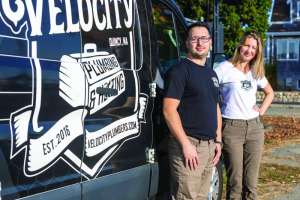
Pecoraro formally established his company “on paper” in 2016, but didn’t leave American until 2017.
“I was scared to tell my bosses I was leaving because they took really good care of me and gave me a lot of freedom and responsibility,” Pecoraro recalls. “I didn’t want to disappoint them.
“But I also wanted to try my own thing, figuring if it didn’t work out, I could go back to American,” he adds. “In the end, they were very nice and supportive, so I try to do the same thing with my guys if they leave to start their own businesses.
“I tell them I’ll help you out and give you advice — just don’t undercut us,” he quips.
BUILDING A BUSINESS
Initially, Pecoraro relied heavily on Facebook and Craigslist to market his fledgling company. Then he used Home Advisor, an internet- and app-based platform that connects homeowners with contractors.
“I used HomeAdvisor for two years,” he says. “After that, I didn’t need it anymore. You pay for every job lead up front, but then I would give customers my name and contact information so they’d call me the next time they needed service. If you get, say, two leads a day for two years, you can establish a pretty good business base.”
To make that business model work, Pecoraro says he had to ensure every customer was happy with his work.
“I wanted to make customers for life,” he notes.
In 2020, Pecoraro — who says he learns a lot by listening to business-related podcasts — decided to subscribe to Housecall Pro, a cloud-based, business-management software platform. For a fee of about $2,000 a year for five users, the platform does everything from scheduling, dispatching and invoicing to managing customer relations, financial reporting and more.
Pecoraro also says his fiancee, Maria Stroppel, played an instrumental role in the company’s growth.
“Maria has been a huge help and boost to my business,” he says. “I knew when we first met that she would be my rock. She helps out when she’s not working on her master’s degree in business administration. Her best skill is organization, an area where I’m lacking.”
EQUIPMENT MATTERS
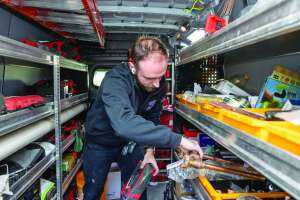
As the company grew, so did its fleet of equipment. Today the company owns four service vehicles: a 2015 and a 2016 Ford Transit 250 cargo van, a 2023 Mercedes-Benz Sprinter 2500 van and a 2022 Ford F-150 pickup truck. The pickup truck is equipped with a liftgate manufactured by Tommy Gate, a brand owned by Woodbine Manufacturing Co., and is used to lift boilers and other heavy items on and off the vehicle.
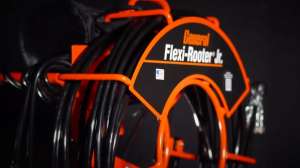
The company also owns several drain machines, including a Milwaukee Tool M12 Drain Snake and a RIDGID K-400 drum cable machine. For pipeline inspections, technicians also rely on a RIDGID microReel SeaSnake camera system.
Technicians primarily use power tools from RIDGID and Milwaukee.
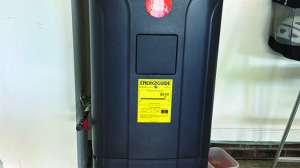
Pecoraro prefers Kohler plumbing fixtures as well as water heaters from A. O. Smith, Rheem Mfg. and Ruud (a brand owned by Rheem) for residential and commercial customers; boilers from Viessman (a Carrier company) and U.S. Boiler Co. for commercial and residential installations; and tankless water heaters from Rinnai America Corp.
Based on customer requests, Velocity also started installing Airstage mini-split, single-room cooling/heating modules from Fujitsu General. They use heat-pump technology, he says.
“We had to get a refrigerant certificate from the EPA , which required taking a course and passing a test,” he says.
Backed by quality technicians and equipment, Pecoraro says he offers something that helps differentiate his company from competitors: a two-year warranty on labor.
“We changed it about two years ago from a one-year to a two-year warranty because we’re so confident about the work we do,” he says. “I don’t think anybody else around here offers a two-year warranty. I think it helps our marketing because customers figure if we’re that confident about our work, they can feel confident, too.”
MAINTENANCE CONTRACTS FUEL BUSINESS
There’s another key to Pecoraro’s success: the introduction about a year ago of annual maintenance and service contracts for residential and commercial customers. For an annual fee, customers get benefits such as a 10% discount on labor and material costs for repairs, priority status over other customers and no extra fee for emergency service calls, Pecoraro says.
The program, which Stroppel helped develop, was created when commercial customers started asking how they could receive priority status for service. After six months, the program was so successful the company expanded it to include residential customers, too.
“It’s been awesome because it builds up recurring work, which is better than waiting for the phone to ring,” Pecoraro says. “A program like this was always on my mind because the real money isn’t in heating-system installations — it’s in maintaining those new installations in the long run.
“It helps with cash flow, too,” he adds. “I wish I had started it years ago.”
What if the demand from contract customers overwhelms the company’s limited worker pool?
Pecoraro says he figures he’ll have to limit enrollment to 100 customers. While the company hasn’t sold nearly that many contracts so far, he’s confident it’s a reachable target.
“I know we’ll hit 100 customers,” he says. “It’s going to snowball.”
A GREAT CAREER
As he looks back, Pecoraro is proud of what he has achieved, especially for a guy who started a business with $100 in a bank account.
“I’m so far away from where I started,” he says. “I feel really good about that.”
Pecoraro also notes that a career in plumbing has been gratifying and rewarding,
“One thing I enjoy the most, which I got hooked on early in my career, is getting paid when the job is done,” he says. “There’s also the satisfaction of solving a problem — especially if someone first called other plumbers who couldn’t solve it.
“When you solve customers’ problems, it makes you feel good,” Pecoraro continues. “It makes this city kid from a trade school feel like a genius.
“I really love plumbing,” he adds. “I truly enjoy working on interesting jobs and the money is just the gravy on top.”
Looking ahead, Pecoraro envisions slow, controlled growth, which reflects his previous bad experience with rapid growth. In the next five years or so, he’d like to top out at eight employees and perhaps expand a little further into the metro Boston area, he says.
“But instead of focusing on volume, we’ll focus on quality,” he points out. “Quality goes much farther than volume in the long run. We want to give customers a great experience all the way through.”