
Being a pastor and a plumber may seem like diametrically opposed careers.
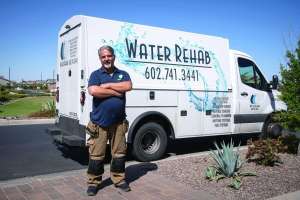
But for Constantin Geambasu, the owner of Water Rehab in suburban Phoenix, they fit together as tightly as a cap fitting on a threaded pipe — and have helped him build a values-based business that builds trust with customers, not to mention repeat business and word-of-mouth referrals.
“The most important thing I’ve learned over the years is that the value of providing a service has nothing to do with money — it’s all about people,” says Geambasu, age 53. “I’m more free because I don’t chase money. I chase value and people, then the money comes to me, which is opposite of what most people think.
“Some businesses value money over people or value other things more than relationships with customers,” he adds. “But we value fellowship with customers and employees.”
Even the name of his company — based in Gilbert, about 23 miles southeast of downtown Phoenix — reflects the company’s spiritual foundation, Geambasu notes.
“I take bad water and make it good — put it through rehab,” he explains. “For me, work is another vehicle to reconcile people with Him.
“Plumbing offers a way to get my foot in the door to help meet people’s needs,” Geambasu continues. “They know they can trust me for plumbing, but they also see the person and values behind it. That’s how I believe a business should be.”

DUAL ROLE
Geambasu entered the plumbing industry in a roundabout way. As a licensed and ordained pastor of a church in a city in Romania in the 1990s, he needed to boost his income.
“I needed two jobs, so I opened a plumbing shop because it was something most people didn’t want to do,” he says. “I decided to try it and realized I liked it — and I was good at it, too. I liked everything about it.
“People have a problem that they cannot solve and you solve it and get to be the hero of the day,” he continues. “How can you not like that?”
Geambasu also loved the interaction with customers.
“Talking to people and developing relationships with customers is my favorite part of the job,” he says.

TRANSITION TO FULL-TIME PLUMBING
When Geambasu moved to the United States in 2011, he was hired by a plumbing company in Mesa, a Phoenix suburb, that did new-construction plumbing. After three years there, he took a job with a company in nearby Tempe that installed water treatment systems.
“They didn’t have a plumbing division, so they hired me,” he explains.
But when that company was bought by a large corporation in 2019, Geambasu decided to strike out on his own, equipped with nothing more than a cargo van, plumbing tools and his faith.
Today, about 90% of the company’s work is residential and focuses on four main areas: general service and repair, including cleaning small drain lines and small remodeling projects; installing water treatment systems; installing misting systems and maintaining water treatment and misting systems.
“I have one guy who does plumbing and drain cleaning, a guy that does water treatment, a guy that does misting and a guy that does maintenance,” Geambasu says. “But they all know how to handle all four areas.”

DIVERSIFIED SERVICES
Unlike many plumbers who start out doing service and repair work and slowly branch out into other services as customers ask for them, Geambasu offered all four of his services from the start.
“I saw that they all intersect and keep the business flowing,” he explains. “When one area goes slow, the other ones pick up. I’ve mostly had just slow but steady growth, not a lot of feast and famine.
“Also, I like operating in those four areas and most of my customers have all four of those areas in their homes,” Geambasu adds. “So why not offer all four services?”
The road to success turned a little rocky after about two years when Geambasu had to hire employees. He didn’t realize how much expenses would increase for things such as liability and vehicle insurance, materials and so forth.
“My overhead went crazy — everything changed,” he says. “I thought I would make more money, but it didn’t work out like that. I didn’t pay myself much for about a year — it was brutal.
“It helped me understand how people can lose a business."

SCHOOL OF HARD KNOCKS
How did Geambasu make it this rough stretch? For starters, he had saved money during the first two years, which helped him survive. In addition, employees became more proficient and efficient, which boosted productivity. Furthermore, Geambasu figured out ways to reduce costs.
“My employees also raised the quality of their work, which in turn raised the volume of work, mostly through word-of-mouth referrals,” he says.
To differentiate his company from competitors, Geambasu also started including in his prices services that other plumbers provided only for additional fees. For example, he included water heater, reverse-osmosis filter and water softener inspections at no extra charge — and also made a point of explaining that to customers.
“I bundled all these things together for one price and people saw the difference,” he explains. “By providing more value, I obtained more work. My employees were happier because people were excited and wanted us in their houses.
“Our employees helped us develop personal relationships with customers,” Geambasu continues. “We want them to feel like they’re part of our family, compared to just slapping things together and you’re out of there.
“They know we’re protecting their family and their money, which should be the mentality of a good service company.”
Great employees also made a difference. Both of Geambasu’s sons — Daniel, 23, and Andrew, 18 — are employees, although Andrew is leaving soon to join the U.S. Air Force. And Larry Nicely, the company’s head plumbing supervisor, provided stability and experience; in fact, Nicely hired Geambasu when he first came to the U.S.
“When he heard I was starting my own company, he came to work with me,” Geambasu says.

EQUIPMENT MATTERS
To care for customers, the company owns three service vehicles: a 2021 Mercedes-Benz Sprinter 3500 cutaway box truck with a body by The Knapheide Mfg. Co. and two Nissan NV cargo vans.
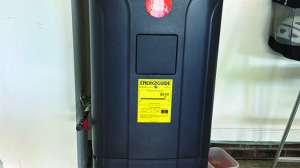
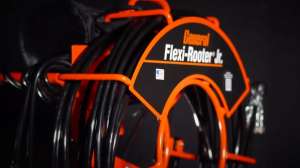
Geambasu prefers power tools from Milwaukee Tool; toilets and fixtures from American Standard, Moen and Delta; tankless water heaters from Navien; conventional water heaters from Bradford White and Ruud (owned by Rheem Mfg. Co.); a pipeline-inspection camera from Milwaukee Tool; and drain machines from Gorlitz Sewer & Drain.
“Larry told me for years that we should clean drains because he loves to do it,” Geambasu says. “I eventually realized that I couldn’t be selfish and not offer our customers this service.”
Geambasu also differentiates his business by doing deep research dives into the products he offers to customers. For example, he likes Bradford White water heaters because he learned they feature an enamel coating inside the tank called Vitraglas that protects against corrosion, he says.
“I go directly to manufacturers’ facilities to see how their products are made,” he says. “I want to see the product inside and out.”
Furthermore, Geambasu likes to get employees certified to work on as many manufacturers’ products as possible because it generates warranty work.

OUTDOOR AIR CONDITIONING
For misting systems, which are commonly used in the Phoenix area to keep outdoor areas cool during torrid summer days, Geambasu prefers systems made by Precision Mist. He says a misting system can keep a porch or pergola area about 22 degrees cooler than the outdoor temperature.
“The air here is very dry, so misting systems make all the difference,” he notes. “They create a magnet effect between the cold air and hot air — they reject each other, so the cold air stays in the area and the hot air stays out. You’re basically using principles of nature to your advantage.”
Geambasu says he has a misting system at his home. The system is so effective that Geambasu says he can keep his backyard as cool as the inside of his air-conditioned home.
Installing such systems requires calculating the cubic volume of, say, a pergola area and using an appropriately sized nozzle for the mister.
“If there’s too much mist, you get wet and if there’s not enough, you get too hot,” he says. “You need to strike that perfect balance.”
The systems can be controlled by an app on a cellphone, he adds.

LIMITED GROWTH ENVISIONED
Looking ahead, Geambasu says he’d like to see the company continue to grow, but not at such a rapid pace that quality control and customer service suffers. He thinks having six technicians on board would be ideal, with the caveat that they’d have to be very high-quality technicians.
“I’d like to see organic growth come from the inside, through hiring people we know,” he says. “If they don’t understand the DNA of our company, they’ll never do jobs properly.
“New employees would have to be part of our inner circle — friends, neighbors and customers who know what our DNA is all about.”
As for a succession plan, Geambasu says he envisions his son Daniel taking over after he retires.
“I would definitely love to leave the business as a legacy for our family,” he says.
Continue reading for free